If you have been putting off looking at your student loans, you are in very good company. Most people graduate, start a job, and spend the next few months hoping the loan question sorts itself out. However, it is more manageable than it feels from the outside.
Here is the good news: refinancing is one of the few levers you actually control. You cannot change what school cost. You can, in some cases, change what you pay to borrow the money. This guide walks through what refinancing is, what it costs you to do it, who it genuinely helps, and how to find out where you stand — without any guessing and without affecting your credit score to look.
Read it start to finish and you will know exactly what your next step is.
What student loan refinancing actually is
Refinancing means a new lender pays off your existing student loans and issues you one new loan in their place, with a new interest rate, a new term, and a single monthly payment.
That is the whole mechanic. There is no fine print trick hiding underneath it. The reason it matters is that the interest rate on your original loans was set by a formula, a school year, or your credit history at 18 (or whenever you took out the loans) – none of which reflect who you are now. If your financial picture has improved since you borrowed, a new lender may price you differently.
Two things refinancing is not:
It is not consolidation. Federal Direct Consolidation combines your federal loans into one federal loan with an interest rate that is the weighted average of what you already have, rounded up. Consolidation simplifies your life; it does not lower your rate. Refinancing is a private transaction with a private lender, and the rate is newly underwritten. Those are different products that people mix up constantly.
It is not forgiveness or relief. Refinancing does not reduce your balance. It changes the cost of carrying that balance.
Federal versus private, in plain terms
Most graduates have a mix of both, and the difference matters more than any other detail in this guide.
| Federal loans | Private loans | |
|---|---|---|
| Who lends | The U.S. Department of Education | Banks, credit unions, and other private lenders |
| Rate set by | Congress, fixed for the year you borrowed | The lender, based on your credit and finances |
| Income-driven repayment | Yes | Generally no |
| Forgiveness programs | Yes, including Public Service Loan Forgiveness | No |
| Deferment and forbearance | Standardized federal options | Varies by lender |
| Can be refinanced | Yes — but it becomes a private loan permanently | Yes |
Read that last row twice. When you refinance a federal loan, it stops being a federal loan. Everything in the federal column goes away for that balance, and there is no path back. That single fact drives most of the decision-making in this guide.
What you give up when you refinance federal loans
Admire’s whole reason for existing is to help you compare transparently, so we are going to lead with the downside rather than bury it.
Refinance a federal loan and you permanently give up:
Income-driven repayment. Federal IDR plans tie your monthly payment to your income and family size. If your income drops — a layoff, a career change, a year of graduate school, a decision to take a lower-paying job you actually want — an IDR plan flexes with you. A private loan payment does not.
Forgiveness programs. Public Service Loan Forgiveness can discharge remaining federal balances after 120 qualifying payments while working for a government or eligible nonprofit employer. Refinancing removes that balance from the program permanently. If you are working toward PSLF, or think you might, refinancing federal loans is generally not the move. (There is more detail in our PSLF versus refinancing guide.)
Federal deferment and forbearance. Federal loans have standardized options for pausing payments during hardship, unemployment, or a return to school. Many private lenders offer hardship programs, but the terms vary and are set by the lender rather than by federal rule.
Death and disability discharge. Federal loans are discharged if the borrower dies or becomes permanently disabled. Some private lenders offer similar provisions; you have to check the specific promissory note.
If any of those protections is load-bearing in your life right now, keep your federal loans federal. That is the honest answer, and it is the right answer for a meaningful share of borrowers.
Who refinancing actually helps
With the trade-offs on the table, here is who tends to come out ahead. Think of it as a three-signal test.
Signal one: your income is steady. Not high — steady. Lenders are underwriting your ability to repay a fixed obligation. Twelve months in a stable role, or a strong offer letter in a stable field, is the kind of thing that moves a rate.
Signal two: your credit has come a long way since you borrowed. Most people’s credit at 22 looks nothing like it did at 18. If yours has improved, you may be priced in a different tier than your original loans reflect.
Signal three: you are carrying private loans, or federal loans at a high rate. Private loans are the clearest case, because refinancing them costs you nothing in federal protections — you are simply swapping one private loan for another, and there is no downside beyond the paperwork. Higher-rate federal loans (the Grad PLUS and Parent PLUS families in particular, which carry higher rates and origination fees than Direct Unsubsidized loans) are the next-clearest case, provided you have weighed the protections above.
Three signals is the ideal. Two is usually worth checking. If you have none of them yet, the right move is a plan to get there, not an application today.
And who should wait
- Anyone pursuing PSLF or another federal forgiveness track.
- Anyone whose income is genuinely unpredictable right now — commission-heavy, contract, or between roles.
- Anyone whose credit is actively being repaired and will look materially different in six months.
- Anyone who is still in school, or is about to be. Refinancing works on loans you already have; new borrowing is a different conversation, covered on our private student loans page.
Waiting is not failure. It is timing.
What refinancing can actually save you
Numbers are more useful than adjectives here. These are illustrative scenarios, not offers, and they use round figures to show the shape of the math rather than to predict your result.
A $30,000 balance. Someone carrying $30,000 across a few loans at a blended rate in the high 6s, with about nine years left. Moving that balance down by roughly a point and a half, on the same remaining term, changes the monthly payment modestly — usually in the range of $20 to $25 — and takes a few thousand dollars of interest out of the life of the loan. Real money, though not life-changing money.
A $75,000 balance. This is where the arithmetic starts to matter. On a balance that size, each percentage point of rate is worth several thousand dollars over a ten-year term. A borrower who improved their credit substantially between borrowing and their first promotion is the classic case here.
A $150,000 balance. Professional-degree territory — dentistry, law, pharmacy, medicine. At this size, a rate change of a point or two moves five figures of total interest. It is also the group with the most at stake in the federal-protections question, because these balances are the ones where income-driven repayment and forgiveness are worth the most. The size of the prize and the size of the risk both scale together, which is exactly why this decision deserves an afternoon rather than five minutes.
We work through all three of these in more detail in how much you can save by refinancing.
When a lower monthly payment costs more
Here is the part that gets glossed over most often, so we will be direct about it.
You can lower almost any monthly payment by stretching the term. Take a balance with eight years left, refinance it over fifteen, and the payment drops noticeably — even if the interest rate barely moves. It feels like a win on the first of the month. Over the full term, you can end up paying more total interest than you would have on the original loan.
That is not a reason to avoid a longer term. Sometimes breathing room is exactly what a budget needs, and choosing it deliberately is a perfectly reasonable decision. It is a reason to look at two numbers, always:
- The monthly payment — what this does to your life right now.
- The total cost over the life of the loan — what this actually costs you.
Any comparison that shows you only the first number is showing you half the picture.
Savings or lower interest rates are not guaranteed and depend on your individual financial profile, loan terms, and credit history.
How the refinancing process works
Start to finish, most borrowers move through this in one to three weeks. The work on your side is measured in minutes, not days.
- Gather your loan details. Balance, interest rate, servicer, and loan type for every loan you have. Federal loans live at studentaid.gov; private loans appear on your credit report if you cannot find the paperwork.
- Check your credit. You are entitled to free reports from the three bureaus at annualcreditreport.com. Look for errors before a lender does.
- Decide what you are optimizing for. Lowest total cost, lowest monthly payment, or fastest payoff. These pull in different directions, and knowing your answer in advance makes comparison much faster.
- Compare offers with a soft credit check. This is the step where most people leave money on the table, so it gets its own section below.
- Choose an offer and apply formally. This involves a hard credit inquiry and document upload — usually pay stubs, a photo ID, and loan payoff statements.
- Keep paying your old loans until you see a $0 balance. The new lender pays off the old ones directly, and that transfer takes a few weeks. Payments made in the gap get refunded; a missed payment does not get undone.
Our six-step walkthrough goes deeper on each stage.
How to compare offers without hurting your credit
This is the single most useful thing in this guide, so it gets the plainest explanation we can write.
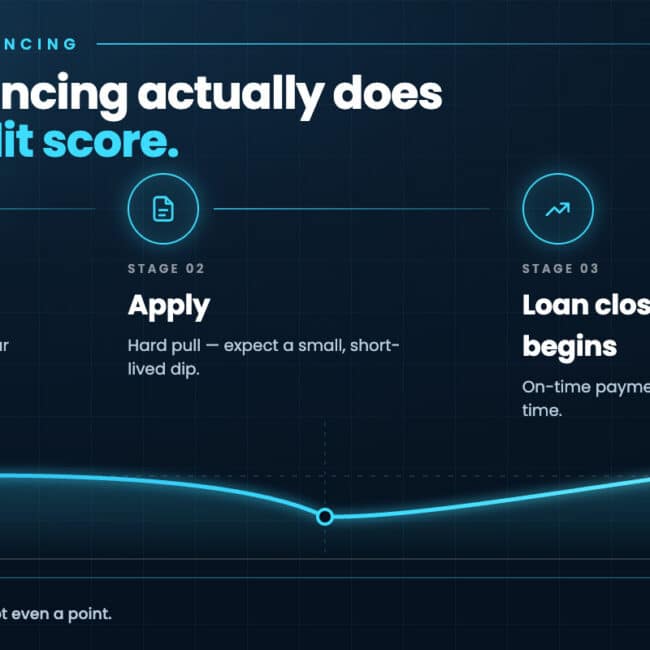
A soft credit check lets a lender estimate what they could offer you. It does not affect your credit score, and you can do as many as you like. This is how rate comparison should start, always.
A hard credit inquiry happens when you formally apply. It can affect your score by a small amount, typically a few points, and it fades over time.
Credit scoring models are built for shopping. When multiple inquiries for the same kind of loan land within a short window — generally somewhere between 14 and 45 days depending on the scoring model — they are typically treated as one event, because the models assume you are comparing offers rather than opening five loans. Shopping several lenders in a two-week stretch is normal behavior that these systems anticipate.
Two rules follow from that:
- Start with soft checks. Get a realistic picture of your options with no credit impact at all.
- If you do apply to several lenders, do it inside a tight window rather than spreading applications across three months.
Admire exists to make the first of those easy. Comparing offers in one place with a soft credit check means you see real numbers from multiple lenders side by side, instead of filling out the same form five times and hoping.
See where you stand
Checking your rate on Admire takes about two minutes, uses a soft credit check, and does not affect your credit score. You will see real offers rather than estimates — and if the numbers do not make sense for you, that is a genuinely useful answer too.
When you do have offers in hand, compare them on five things, in this order: APR (not the headline rate), the term, the total cost over the life of the loan, any fees, and who will service the loan. Our guide to comparing refinancing offers breaks each of those down.
Fixed or variable?
A fixed rate stays the same for the life of the loan. A variable rate is tied to an index, such as the prime rate, and adjusts periodically — which means the payment can move in either direction over time.
Variable rates typically start lower. That is the appeal, and it is a real one. The trade-off is that you are taking on the risk of future increases in exchange for a lower starting point.
A reasonable way to think about it: a variable rate makes more sense the shorter your expected payoff window. If you are planning to clear the balance in three or four years, there is less time for rates to move against you. If you are looking at a ten- or fifteen-year horizon, a fixed rate buys you a number you can plan a decade of life around — rent, a move, a wedding, a down payment — without it changing underneath you.
If you cannot tell yourself with a straight face when the balance will be gone, that is usually an argument for fixed.
If the timing is not right yet
Plenty of people read this far, run the numbers, and conclude the answer is “not today.” That is a real outcome and a useful one. Here is what to do with the next six months:
- Pay on time, every time. Payment history carries the most weight in credit scoring, and autopay removes the failure mode. Many lenders also offer a small rate discount for enrolling in autopay — often around 0.25%.
- Bring down credit card balances. Utilization moves scores faster than almost anything else you control.
- Do not open new credit right before you plan to apply. New accounts and fresh inquiries make a thin file look thinner.
- Let your job tenure build. Twelve months in a role is a meaningful marker for many lenders.
- Check again in six months. Rates change, your file changes, and the soft-check comparison costs you nothing to repeat.
And if your first payment is the thing actually looming, that is a different job with its own checklist — we walked through it step by step in the post-grad repayment playbook.
The cost of doing nothing
We will end where we started, honestly. Refinancing is not right for everyone, and this guide has spent real estate on the cases where it is the wrong call.
But there is a difference between deciding not to refinance and never looking. The first is a decision. The second is interest quietly accruing on a rate that was set before you had a job, a salary, or a credit history worth speaking of. Ten minutes of comparison tells you which situation you are in — and if the answer is “keep what you have,” you get to stop thinking about it and go live your life.
That is the actual goal here. Not a lower rate for its own sake. A number you understand, chosen on purpose, that leaves room for everything else you want the next ten years to include.
Ready to see your numbers?
Compare real offers from multiple lenders in one place, with a soft credit check that will not affect your score.
Admire is not a lender and does not make credit decisions. All rates and terms are determined by participating lenders and depend on your individual financial situation. Not all consumers will qualify for advertised rates and terms. See our full disclaimers.
Frequently asked questions
Does refinancing student loans hurt your credit score?
Comparing offers with a soft credit check has no effect on your score. Formally applying involves a hard inquiry, which typically affects your score by a small amount and fades over time. Multiple inquiries for the same loan type within a short shopping window are generally treated as a single event by credit scoring models.
Can you refinance federal student loans?
Yes, but the balance becomes a private loan permanently. You give up income-driven repayment, federal forgiveness programs including PSLF, and federal deferment and forbearance options. For borrowers who do not rely on those protections, refinancing can lower the cost of the loan; for borrowers who do, it usually is not worth it.
What credit score do you need to refinance student loans?
Requirements vary by lender. Many look for scores in the mid-600s or above, with better pricing at higher tiers, alongside steady income and a manageable debt-to-income ratio. Adding a creditworthy cosigner can help borrowers who do not qualify on their own.
How soon after graduating can you refinance?
Many lenders will consider an application once you have graduated and have income or a signed offer letter, though some prefer to see a few months of employment history. There is no requirement to wait for your grace period to end, but it is worth confirming your first payment date before you make any changes.
Is it better to refinance or consolidate student loans?
They solve different problems. Federal consolidation simplifies multiple federal loans into one and preserves federal benefits, but it does not lower your interest rate. Refinancing may lower your rate but converts federal loans to private ones. If your goal is a lower cost of borrowing, consolidation will not get you there on its own.
Can you refinance more than once?
Yes. There is generally no limit, and no penalty for refinancing again if your credit or income improves or rates move. Each new application involves a fresh credit check and underwriting.