Your credit score often determines what you pay.
When you refinance student loans, lenders use your credit score as a major factor to determine your interest rate. The difference between a 620 score and a 780 score? More than $150 per month. That’s $1,800 annually. Over a 10-year loan, you’re looking at $18,000. Most lenders want to see a score of 700 or higher for refinancing. You can qualify with scores around 650-680, but your rate suffers. The good news: you can move your score in 30-45 days if you know which levers to pull.Start With Payment History
Payment history makes up 35% of your FICO Score. It’s the single largest component. One late payment can drop your score by up to 180 points. That’s not a typo. A single 30-day late payment creates damage that takes months to repair. Here’s what to do:- Set up autopay on every credit account you have
- Pay at least the minimum on time, every time
- If you’ve missed payments, get current immediately
Fix Your Credit Utilization
Credit utilization accounts for 30% of your score. It measures how much of your available credit you’re using. Most advice tells you to stay under 30%. The data shows something different: people with excellent credit scores keep utilization around 7%. Individuals with poor scores average 53%. The math is simple. If you have a $10,000 credit limit, keep your balance below $700. This is the fastest lever you can pull —> pay down your credit card balances, and your utilization drops within one billing cycle. Once your card issuer reports the new balance to credit bureaus, your score can improve in as little as 30 days. Three ways to lower utilization quickly:- Pay down existing balances before your statement closes
- Request a credit limit increase (without opening new accounts)
- Spread charges across multiple cards instead of maxing one
Time Your Applications Strategically
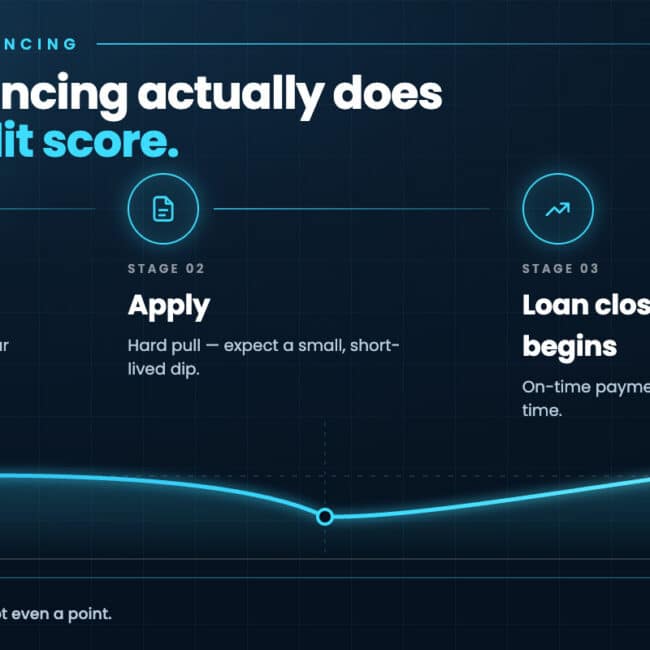
When you compare refinancing rates, lenders run a soft credit check. While soft pulls don’t affect your score, checking your rate at each lender individually is quite time consuming. Tools like Admire let you compare personalized rates from multiple lenders with just one soft pull, so you can see what rates you qualify for without impacting your credit score. After comparing offers, when you actually apply to refinance, the lender will run a hard inquiry. For most individuals, hard inquiries drop your score by fewer than 5 points.Remove Errors From Your Credit Report
Pull your credit report from all three bureaus: Equifax, Experian, and TransUnion. Look for:- Accounts that don’t belong to you
- Incorrect late payment marks
- Duplicate accounts
- Outdated negative information (most items should drop off after 7 years)
Consider Becoming an Authorized User
If someone with good credit adds you as an authorized user on their credit card, their payment history can appear on your credit report. This works best when:- The primary cardholder has a long history of on-time payments
- The card has low utilization
- The card issuer reports authorized users to credit bureaus
Don’t Close Old Accounts
Length of credit history matters. Closing old accounts shortens your average account age and can hurt your score. Keep old accounts open, even if you don’t use them regularly. Put a small recurring charge on them and set up autopay to keep them active.Understand the Timeline
Credit score improvements follow a pattern:- 30-45 days: Utilization changes and error removals show up
- 3-6 months: Consistent on-time payments start rebuilding payment history
- 6-12 months: New positive patterns establish themselves