You’re staring at two refinance offers. One locks in at 5.2% fixed. The other starts at 3.5% variable.
The math seems obvious until you realize you’re solving for the wrong question.
Most borrowers treat this as a risk tolerance problem. Safe versus risky. Predictable versus gambling. But the actual decision has nothing to do with your comfort with uncertainty.
It’s about whether you understand how rate environments work and how fast you plan to pay this thing off.
Variable Rate: What You’re Actually Trading
Advantages:
- Lower starting rate – Typically 1% to 2% below comparable fixed rates, meaning immediate savings when your balance is highest
- Captures rate decreases – If the Fed cuts rates, your rate drops automatically without refinancing again
- Frontloaded savings – You pay less interest early when it’s calculated against your largest balance
- Wins in 3 out of 4 scenarios – Outperforms fixed rates unless rates spike dramatically and quickly
- Rate caps limit exposure – Maximum rates are contractually defined, turning unlimited risk into calculable worst-case scenarios
Disadvantages:
- Payment uncertainty – Your monthly payment can increase, making budgeting less predictable
- Rate risk over time – The longer your repayment timeline, the more exposure you have to potential rate increases
- Requires active monitoring – You need to track rate movements and potentially refinance if conditions shift unfavorably
- Psychological discomfort – The lack of certainty creates stress for some borrowers, even when the math supports the choice
Fixed Rate: The Certainty Premium
Advantages:
- Payment predictability – Your rate and monthly payment never change, making long-term budgeting effortless
- Protection against spikes – If rates increase dramatically, you’re completely insulated from the impact
- Set-and-forget simplicity – No need to monitor rate environments or consider re-refinancing
- Better for long repayment timelines – The longer you’re paying, the more valuable rate protection becomes
- Mental clarity – Eliminates the cognitive load of wondering whether rates will rise
Disadvantages:
- Higher starting rate – You typically pay a premium (typically 1-2%) for rate certainty from day one
- Misses rate decreases – If rates drop, you’re locked in unless you refinance again (which costs time and potentially fees)
- Overpays in most scenarios – Historical data shows fixed rates cost more in 3 out of 4 interest rate environments
- Opportunity cost – The premium you pay for certainty could have reduced principal faster with a variable rate
- Inefficient for short timelines – If you’re paying off quickly, you’re buying protection you’ll never need
The Three-Out-Of-Four Reality
There are exactly four scenarios that can happen with interest rates after you refinance.
Rates stay flat. Rates drop. Rates rise slowly. Rates spike fast.
In three of those four scenarios, the variable rate loan outperforms. That’s not speculation. That’s structural math.
If rates stay flat, you’re paying less from day one because variable rates typically start 1% to 2% lower than comparable fixed rates. If rates drop, your variable rate drops with them. If rates rise slowly, you still come out ahead because you banked savings early when your balance was highest.
The only losing scenario is a fast, dramatic spike. And even then, the timing matters more than most people realize.
Your Balance Shrinks While Rates Rise
Here’s the part the fixed-rate pitch doesn’t mention.
When you start repayment, your loan balance is at its peak. That’s when the interest rate matters most. Every dollar of interest gets calculated against a five or six figure balance.
By the time rates have climbed in a rising environment, you’ve already paid down a significant chunk of principal. The rate is higher, but it’s applied to a smaller number.
Take a real example: You have a $100,000 loan with a 5-year repayment plan. You choose a variable rate starting at 3.5%. Over the next five years, rates climb steadily—4.5% in year two, 5.5% in year three, 6.5% in year four, and 7.5% by year five.
Compare that to locking in a 5.5% fixed rate from the start.
With the variable rate, you pay approximately $14,200 in total interest. With the fixed rate, you pay approximately $15,200. You save roughly $1,000 even though rates more than doubled, because you captured the lower rate when your balance was highest—when interest costs actually mattered.
The math works because you frontloaded the savings when they mattered most.
The Five-Year Window
Historical context gives you boundaries.
Over the last 20 years, interest rates have never increased more than five percentage points in a five-year period.
That doesn’t mean it can’t happen. But it does mean the “worst case scenario” most borrowers imagine is worse than anything the market has actually delivered in two decades.
If you’re planning to pay off your loan in three to five years, the variable rate advantage compounds. You maximize the benefit of the lower starting rate. You minimize exposure to future increases. You’re done before the worst-case timeline even becomes relevant.
The shorter your repayment window, the more the variable rate math tilts in your favor.
Rate Caps Aren’t Theoretical
Most variable rate loans come with a cap. It’s not unlimited exposure.
SoFi’s variable rate refinance loans, for example, cap at 8.95% or 9.95% depending on your term. No matter what happens to the underlying index, you’ll never pay more than that ceiling.
That cap turns “unlimited risk” into “calculable maximum cost.” You can model the absolute worst-case scenario and compare it directly to the fixed rate offer.
The 2026 Rate Environment
As of January 2026, the spread between fixed and variable has compressed to almost nothing in some cases.
The Federal Reserve made three consecutive 25-basis-point cuts in 2025, bringing rates to a range of 3.5% to 3.75%. The median expectation for 2026 is another 50 basis points of cuts across two meetings.
Translation: If you lock in a variable rate now, you’re entering during a declining rate environment. The odds favor you capturing additional savings as cuts happen, not fighting against increases.
That doesn’t make variable rates automatically correct for everyone. But it does mean the decision isn’t about guessing the future. It’s about reading the present conditions and matching them to your repayment plan.
What Actually Changes the Decision
The variable versus fixed question collapses into two variables.
How fast are you paying this off?
If you’re on a ten-year plan, you’re exposed to a full decade of rate volatility. The fixed rate hedge makes more sense. If you’re on a three-year sprint, rate increases barely touch you. Variable wins.
What’s the current rate spread?
If the variable rate starts 2% lower than fixed, you’re banking serious savings early. If the spread is 0.25%, the advantage shrinks and the fixed rate’s predictability becomes more appealing.
Everything else is noise. Risk tolerance doesn’t matter if the math doesn’t support the risk. Market predictions don’t matter if your loan is paid off before they play out.
The decision isn’t about whether you’re conservative or aggressive. It’s about whether you’ve done the calculation that matches your repayment timeline to the rate environment you’re actually entering.
Most borrowers skip that step. They pick fixed because it feels safer, not because it costs less.
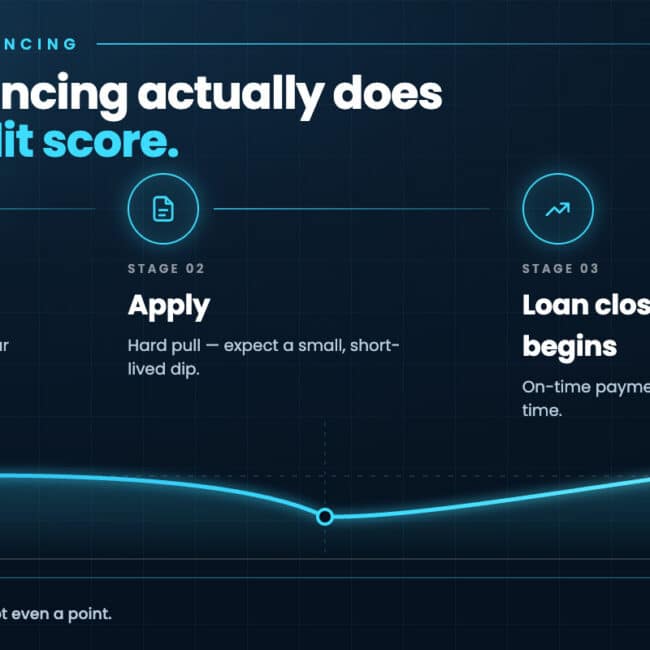
You can compare both fixed and variable rate options side-by-side on Admire—see actual offers from multiple lenders, model different repayment timelines, and run the math on your specific situation without impacting your credit score.
You don’t need to guess what rates will do. You need to know what you’re going to do, and then pick the structure that rewards that behavior.
The variable rate isn’t the risky choice. It’s the choice that requires you to have a plan.