Everyone talks about the debt. Nobody compares the debt.
A medical student graduating with $216,000 and a dental student graduating with $280,000 are in very different positions, even though both owe “a lot.” The difference isn’t just the number. It’s the salary that services the debt, the career timeline that determines when you’re solvent, and the repayment strategy that makes the math work.
This is the side-by-side comparison nobody gives you before you commit to a program. Every number here is from 2025-2026 data, adjusted for the new OBBBA borrowing caps taking effect July 1, 2026.
The Headline Numbers: Average Debt by Professional Program
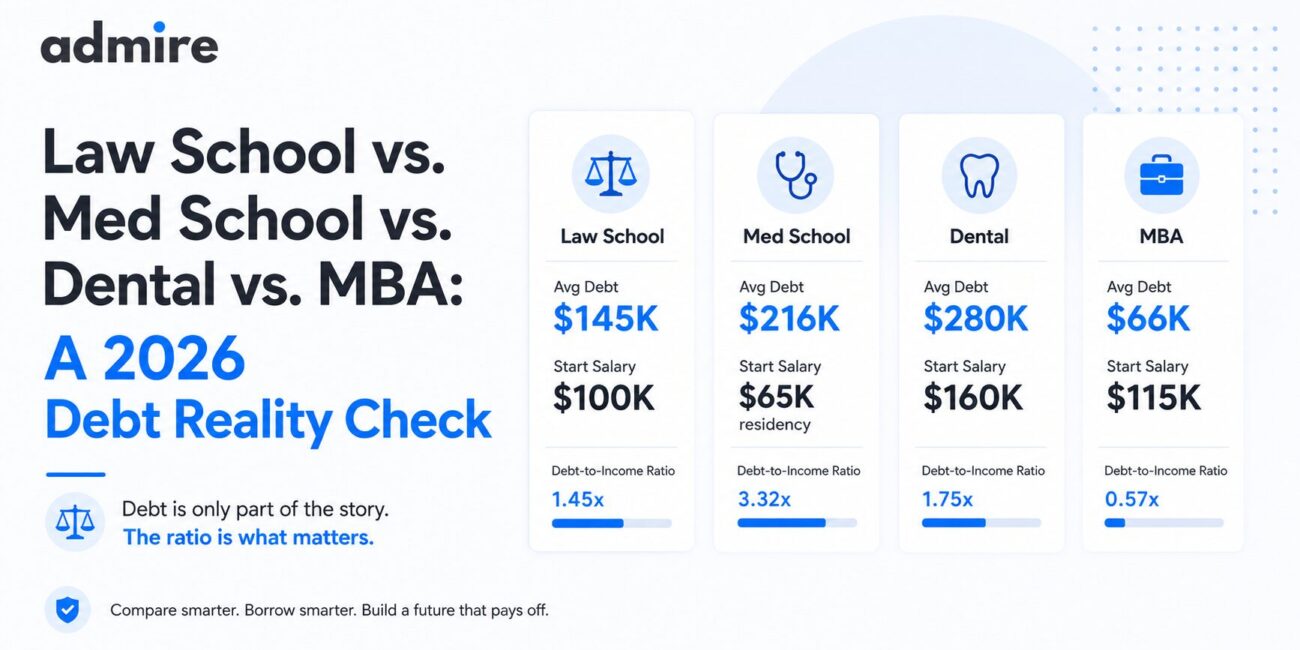
| Program | Avg. Debt at Graduation | Median Starting Salary | Debt-to-Income Ratio |
|---|---|---|---|
| Medical School (MD/DO) | $216,659 | $65,000 (residency) | 3.3x |
| Dental School (DDS/DMD) | $280,000 | $160,000 | 1.75x |
| Law School (JD) | $145,000 | $100,000 (median) | 1.45x |
| Pharmacy School (PharmD) | $170,000 | $132,000 | 1.29x |
| MBA (Full-Time) | $66,000 | $115,000 | 0.57x |
The debt-to-income ratio in the far right column is the number that actually matters. A $66,000 MBA debt on a $115,000 salary is fundamentally manageable. A $216,000 medical school debt on a $65,000 residency salary is a financial emergency (temporarily). Context changes everything.
But What Does Repayment Actually Look Like?
Here’s what monthly repayment costs at each debt level, assuming current federal rates (7.94% for graduate loans) on a standard 10-year plan, and what it looks like after refinancing at 4.5%:
| Program | Monthly Payment (Federal 10-yr) | Monthly Payment (Refi 4.5%, 10-yr) | Monthly Savings from Refi |
|---|---|---|---|
| Medical ($216K) | $2,638 | $2,237 | $401/mo ($48,120 total) |
| Dental ($280K) | $3,419 | $2,900 | $519/mo ($62,280 total) |
| Law ($145K) | $1,771 | $1,501 | $270/mo ($32,400 total) |
| Pharmacy ($170K) | $2,076 | $1,760 | $316/mo ($37,920 total) |
| MBA ($66K) | $806 | $683 | $123/mo ($14,760 total) |
The dental column should give you pause. At $3,419/month on federal rates, a new dentist earning $160,000 (about $10,000/month after taxes) is sending more than a third of take-home pay to loan servicers. That’s before rent, malpractice insurance, and the equipment loans that many new dental practitioners carry.
The New OBBBA Reality: Borrowing Caps by Program Type
Starting July 1, 2026, new graduate borrowers face hard federal limits for the first time:
| Program Type | New Annual Cap | New Lifetime Cap | Typical Annual Cost | Annual Gap |
|---|---|---|---|---|
| Medical School | $50,000 | $200,000 | $65,000-$85,000 | $15,000-$35,000 |
| Dental School | $50,000 | $200,000 | $70,000-$90,000 | $20,000-$40,000 |
| Law School | $50,000 | $200,000 | $50,000-$70,000 | $0-$20,000 |
| Pharmacy | $50,000 | $200,000 | $40,000-$55,000 | $0-$5,000 |
| MBA | $50,000 | $200,000 | $50,000-$80,000 | $0-$30,000 |
Medical and dental students at high-cost schools face the largest gaps. These gaps will need to be filled with private loans, institutional aid, employer sponsorship, or a combination. The era of borrowing whatever the school charges from the federal government is over.
The Break-Even Analysis: When Does the Degree Pay for Itself?
This is the question most prospective students forget to ask: how long after graduation until the degree has generated more income than it cost?
| Program | Total Cost (4 yrs tuition + opportunity cost) | Salary Premium Over Bachelor’s | Break-Even Point |
|---|---|---|---|
| Medical School | ~$450,000 | ~$200,000/year (post-residency) | ~8 years after residency |
| Dental School | ~$420,000 | ~$100,000/year | ~7 years |
| Law School | ~$280,000 | ~$40,000/year (median) | ~10 years |
| Pharmacy | ~$310,000 | ~$70,000/year | ~6 years |
| MBA | ~$200,000 | ~$55,000/year | ~5 years |
The MBA has the shortest payback period because the degree is shorter (2 years vs. 4) and the opportunity cost is lower. Medical school has the longest because residency delays the high-earning phase by 3 to 7 years. Law school’s break-even is deceptive: the median salary of $100,000 masks a bimodal distribution where BigLaw associates earn $215,000+ and public interest lawyers earn $55,000. Your break-even depends entirely on which track you land on.
Optimal Strategy by Profession
Physicians:
PSLF is the strongest play if you’ll be at a nonprofit hospital for 10 years (residency counts). If heading to private practice, refinance after residency when your DTI ratio drops dramatically. The attending transition is the optimal refinancing moment.
Dentists:
Most dentists enter private practice (for-profit), making PSLF unavailable. Refinancing immediately after graduation or residency is typically the best path. The high balance means interest savings from a lower rate compound quickly. A 3-point rate reduction on $280K saves over $60,000.
Lawyers:
Bifurcated strategy. BigLaw associates should refinance and pay aggressively (high income makes this feasible within 3-5 years). Public interest lawyers should maximize PSLF (qualifying employers are abundant in government and nonprofit legal work).
Pharmacists:
Corporate pharmacy positions (CVS, Walgreens, hospital systems) may or may not qualify for PSLF depending on the employer’s nonprofit status. Check first. If PSLF isn’t available, refinancing at lower rates and aggressive payoff on a solid salary is the standard approach.
MBAs:
The lowest debt and highest immediate salary premium make this the simplest case. Refinance if rates are favorable, pay aggressively, and be debt-free in 3-5 years. PSLF rarely makes sense given the relatively small balance and high income.
One Number That Matters More Than Your Debt Total
Your debt-to-income ratio determines your financial flexibility, your refinancing rate, your mortgage eligibility, and your stress level. Two borrowers can owe the same amount and be in completely different financial positions based on their income.
The general guidelines:
- Below 1.0x: Very manageable. Aggressive payoff is feasible within 3-5 years.
- 1.0x to 1.5x: Manageable with a plan. Refinancing typically makes sense.
- 1.5x to 2.5x: Requires a deliberate strategy. Consider PSLF if eligible; refinancing if income growth is imminent.
- Above 2.5x: Income-driven repayment may be necessary in the short term. This is common for residents and new graduates in extended training.
More on how DTI affects your refinancing options: Your Credit Score Qualifies You. Your DTI Ratio Prices You.
Frequently Asked Questions
Which professional degree has the most student loan debt?
Dental school graduates carry the highest average debt at approximately $280,000, followed by medical school at $216,659. However, debt-to-income ratio matters more than the total.
How long does it take for a professional degree to pay for itself?
MBAs break even fastest at roughly 5 years. Pharmacy at 6 years, dental at 7, medical school at 8 years after residency. Law school averages 10 years but varies dramatically between BigLaw ($215K+) and public interest ($55K).
Should doctors refinance or pursue PSLF?
Physicians at nonprofit hospitals should pursue PSLF, where residency counts toward 120 payments. Those heading to private practice should refinance after residency when their attending salary qualifies them for the best rates.
What are the new OBBBA borrowing caps for professional students?
Starting July 1, 2026, all professional students face a $50,000 annual cap and $200,000 lifetime cap on federal borrowing. Medical and dental students at high-cost programs face annual funding gaps of $15,000 to $40,000.
The Bottom Line
The headline debt number is noise. What matters is the ratio of what you owe to what you earn, the repayment strategy that fits your career path, and whether you make that choice deliberately or let default settings decide for you.
Every profession has a path through six-figure debt. The trick is knowing which path belongs to yours.
This article was researched and written by the Admire editorial team, drawing on federal student loan data, OBBBA legislation, and current lending market analysis. Admire.org is a borrower-first student loan marketplace. We are not a lender. Learn how Admire works.