When you start shopping for student loan refinancing, you’ll quickly be presented with rates, terms, and monthly payments from multiple lenders. It’s easy to fixate on the interest rate alone — but the lowest advertised rate doesn’t always mean the best deal for your situation.
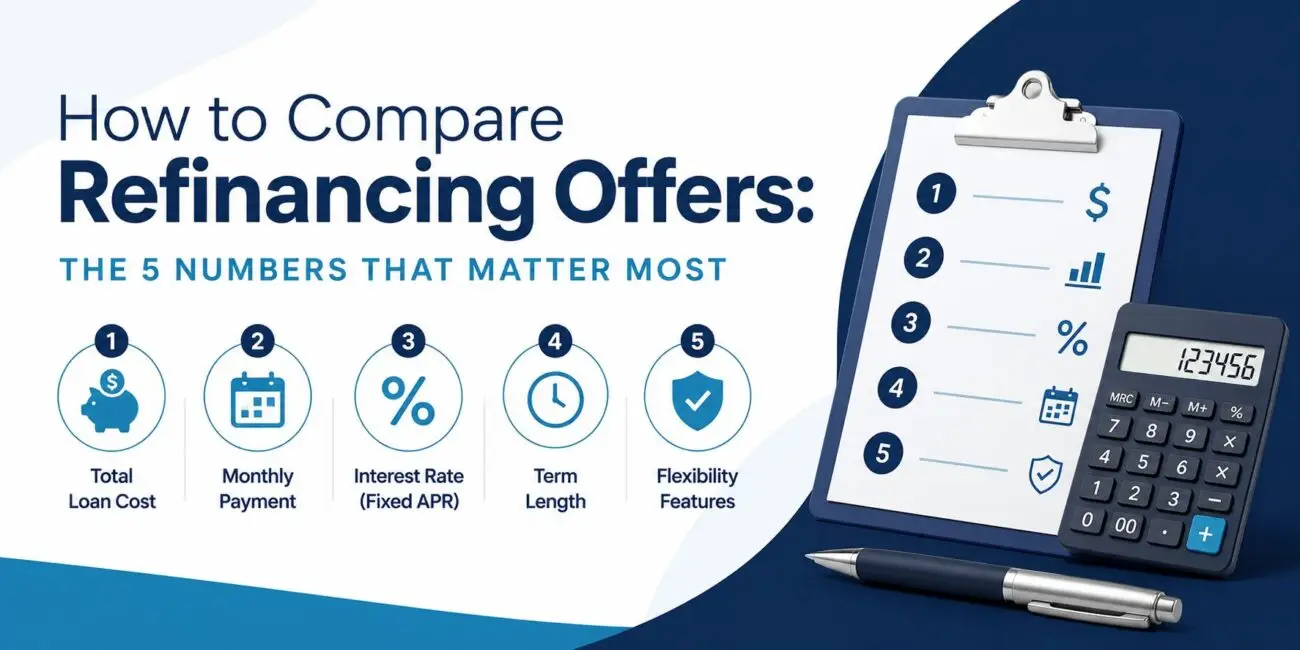
Here are the five numbers that actually determine whether a refinancing offer saves you money, and how to evaluate them.
1. Total Loan Cost
This is the single most important number. Total loan cost is the sum of every dollar you’ll pay over the life of the loan — principal plus all interest. It answers the simplest question: “How much will this loan cost me from start to finish?”
Why it matters more than the interest rate alone: A lower rate on a longer term can actually cost you more than a slightly higher rate on a shorter term. For example:
- $120,000 at 4.5% for 15 years = ~$165,100 total cost
- $120,000 at 5.0% for 10 years = ~$152,700 total cost
The higher rate on the shorter term saves over $12,000. That’s why total loan cost is the real metric that matters.
2. Monthly Payment
Total loan cost tells you the best deal mathematically. Monthly payment tells you whether you can actually afford it. Both numbers need to work.
When comparing monthly payments across offers, ask:
- Can I make this payment comfortably every month without cutting into essential expenses or emergency savings?
- If I chose a shorter term with a higher payment, would I still be able to handle an unexpected expense?
- Does the payment leave room for other financial goals (retirement contributions, home purchase savings)?
The ideal refinancing offer has the lowest total cost at a monthly payment you can sustain.
3. Interest Rate (Fixed APR)
The interest rate determines how much you’re charged to borrow. When comparing rates:
- APR vs. interest rate: Always compare the APR (Annual Percentage Rate), which includes any fees. For most student loan refinancing lenders, the APR and the interest rate are the same because there are no origination fees — but verify this.
- Fixed rates stay the same for the life of the loan, giving you a predictable monthly payment from start to finish.
- Autopay discount: Most lenders offer a 0.25% rate reduction for enrolling in automatic payments. Make sure you’re comparing rates on an apples-to-apples basis — some advertised rates include the discount, others don’t.
4. Term Length
The repayment term — typically ranging from 5 to 20 years — is the lever that connects your monthly payment to your total cost. Here’s the tradeoff:
| Shorter Terms (5-7 years) | Longer Terms (15-20 years) |
|---|---|
| Higher monthly payments | Lower monthly payments |
| Significantly less total interest | More total interest over time |
| Often comes with a lower interest rate | Rate may be slightly higher |
| Debt-free faster | More cash flow flexibility |
Some lenders allow you to choose your exact term length (e.g., 8 years, 12 years) rather than standard increments. This can help you fine-tune the monthly payment to exactly what works for your budget.
5. Flexibility Features
The numbers get you most of the way, but flexibility features can be the tiebreaker between similar offers:
- Forbearance options: Can you temporarily reduce or pause payments if you lose your job or face a financial hardship? How long is forbearance available, and does interest continue to accrue?
- No prepayment penalties: You should be able to pay more than the minimum — or pay off the loan entirely — without any fees. This is standard among reputable refinancing lenders, but always confirm.
- Cosigner release: If you’re using a cosigner, does the lender allow cosigner release after a set number of on-time payments?
- Death and disability discharge: Does the lender discharge the loan if the borrower dies or becomes permanently disabled? Policies vary.
How to Put It All Together
When you have offers from multiple lenders, create a simple comparison:
| Factor | Offer A | Offer B | Offer C |
|---|---|---|---|
| APR | ? | ? | ? |
| Term | ? | ? | ? |
| Monthly Payment | ? | ? | ? |
| Total Loan Cost | ? | ? | ? |
| Fees | ? | ? | ? |
| Forbearance Available? | ? | ? | ? |
Fill in the details from each lender’s offer. Start with total loan cost — the offer with the lowest total cost at a monthly payment you can sustain is usually the right choice.
The Easiest Way to Compare
Admire.org was built specifically for this. With a single soft credit pull — no impact to your credit score — you can see personalized offers from multiple lenders side by side. Instead of submitting separate applications to each lender, you compare in one place and then decide.
Frequently Asked Questions
Should I always pick the lowest rate?
Not necessarily. The lowest rate might come with a term that doesn’t match your needs, or from a lender with limited forbearance options. Total loan cost is usually a better deciding factor than rate alone.
Are there fees for refinancing student loans?
Reputable student loan refinancing lenders typically charge no origination fees, no application fees, and no prepayment penalties. If a lender does charge fees, factor them into your total cost comparison.
Can I refinance again later if rates drop?
Yes. There’s no limit on how many times you can refinance. If your credit improves or market rates drop, refinancing again could save you additional money.
Disclaimer: This article is for informational purposes only and does not constitute financial advice. Rates, terms, and eligibility requirements are subject to change. Refinancing federal student loans with a private lender means losing access to federal benefits such as income-driven repayment, forgiveness programs, and deferment options. Individual results vary based on creditworthiness, loan balance, and lender criteria. Always review the full terms before making a decision.