This is the question that stops people at the last step.
You have decided refinancing your student loans makes sense. You know roughly what you would save. And then a small worry surfaces: you are about to apply for credit at the exact moment you might also be thinking about a car, an apartment, or eventually a mortgage, and you do not want to damage your score to save on interest.
A reasonable concern. Here is the honest version of the answer: refinancing does impact your credit, in three separate ways, and the effects are smaller and shorter-lived than most people expect. Once you can see the three pieces separately, the worry usually resolves itself.
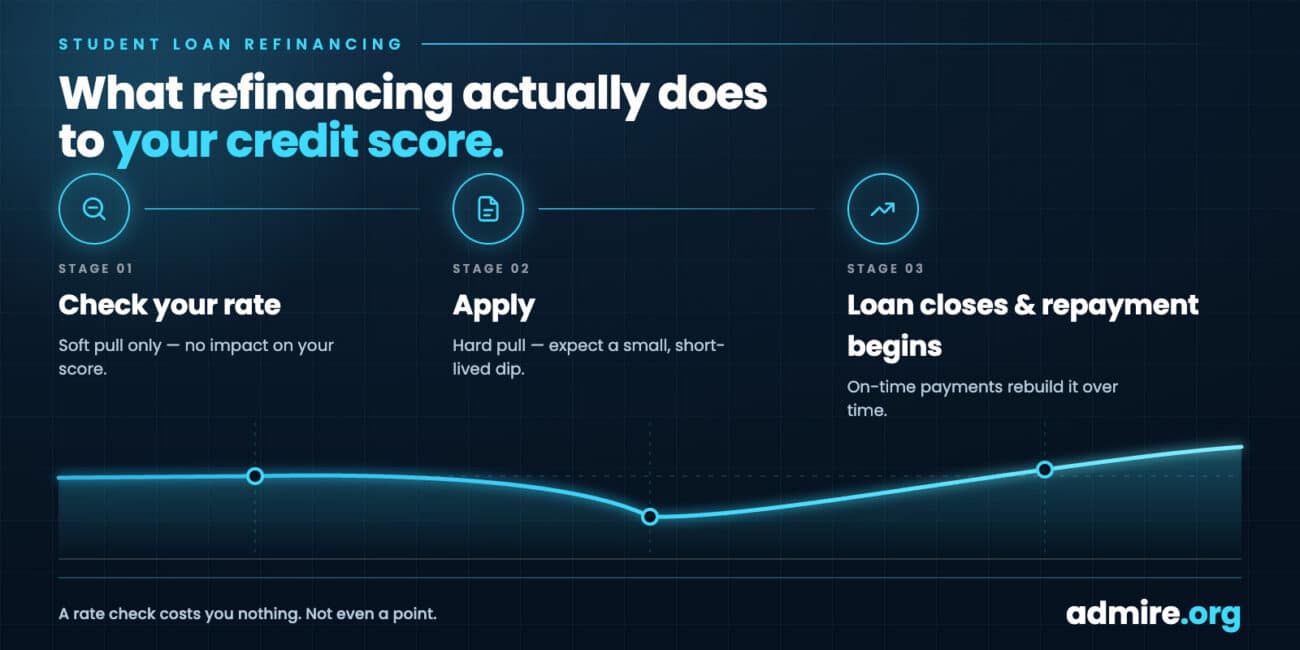
The three things that actually affect your score
Refinancing is not one event. It is three, and they do different things.
1. Checking your rate. Usually a soft inquiry. No effect on your score at all.
2. Formally applying. A hard inquiry. Small, temporary effect.
3. The old loan closing and a new one opening. A change to your credit mix and account age. Small, and it partly reverses.
Most of the anxiety around this question comes from collapsing all three into one vague fear. Taken one at a time, they are manageable.
Soft pull vs. hard pull, in plain English
A soft inquiry happens when a lender looks at your credit to estimate what they could offer you. It does not affect your score. You can do it repeatedly. Only you see it on your report.
A hard inquiry happens when you formally apply and a lender makes a real lending decision. It stays on your report for about two years, and it is visible to other lenders. Its effect on your score is typically small — usually a few points — and it fades within months.
The practical consequence: you can see real numbers before anything is at stake. Rate checks through a marketplace generally use a soft pull, which means comparing offers from several lenders costs you nothing in credit terms. The mechanics are covered in more depth in how to use soft credit checks to compare loans.
One caveat worth stating plainly: a soft-pull estimate is an estimate. The final offer comes after the hard pull and full verification, and it can differ from the preview if something in your documentation does not match what was estimated. It is a reliable guide, not a contract.
The rate-shopping window
Here is the part that surprises people, and it is the single most useful thing in this article.
Credit scoring models are built by people who know that shopping for one loan means talking to several lenders. So when multiple inquiries for the same kind of loan land close together, the models treat them as one shopping event rather than several separate applications.
The exact window depends on which scoring model a lender uses — it is commonly somewhere in the range of two weeks to about six weeks. Because you cannot know in advance which model will be applied, the safe approach is simple:
Do all of your rate shopping inside a two-week span.
Two weeks fits comfortably inside every common version of the window. That single habit removes most of the credit cost of comparing lenders properly.
What this rules out is the drawn-out approach — an application in September, another in November, another in January. Those are three separate events to a scoring model, and that is the pattern that actually leaves a mark. Shopping harder in a short window is better for your score than shopping casually over a long one.
See your numbers before anything touches your credit
Admire’s Find My Rate tool shows offers from multiple lenders using a soft credit check, so you can compare real terms without a hard inquiry. If nothing looks better than what you have, you close the tab and your score never knew you were there.
What happens to the old loan
When refinancing completes, your original loans are paid off and closed, and a new account opens in their place. Two things follow.
Your average account age drops. The old loans, opened while you were in school, are probably some of the oldest accounts you have. Replacing them with a brand-new account lowers the average age of your credit history, which is one factor in your score. This is usually a small effect, and it rebuilds over time simply by the new account getting older.
Your credit mix stays roughly the same. You are swapping one installment loan for another, so the category does not change. Refinancing several loans into one reduces the number of open accounts, which is a minor factor either way.
There is also a positive that gets overlooked. A refinanced loan often carries a lower monthly payment, which improves your debt-to-income ratio — and while DTI is not part of your credit score, it is very much part of how a mortgage underwriter looks at you. For some borrowers that helps more than the few points from the inquiry hurt.
The realistic timeline
From first rate check to old loans closed, refinancing usually runs a few weeks. Roughly:
- Rate check — minutes, soft pull, no score impact.
- Full application and documents — you provide income verification, ID, and payoff statements for the existing loans. Hard pull happens here.
- Underwriting and approval — the lender verifies everything.
- Payoff period — the new lender sends funds to your old servicers. This step takes the longest and is largely out of your hands.
- First payment to the new lender.
Two things to watch during step 4. Keep paying your old loans until you have written confirmation that they are paid off. A missed payment during the transition does far more damage to your score than the hard inquiry ever will. And check the old accounts a few weeks later to confirm they show a zero balance and a closed status.
When to wait
Refinancing is not the right move for every calendar. Some cases where waiting is the better call:
- You are applying for a mortgage in the next few months. Not because a refinance is disqualifying — it usually is not — but because underwriters prefer stability, and a new account plus a recent inquiry is a conversation you do not need mid-application. Talk to your loan officer first.
- Your credit is actively improving. If you are a few months from paying off a card or clearing a late payment off your record, waiting can move you into a better pricing tier. What drives those tiers is covered in how lenders price refinancing.
- You have federal loans and have not thought through what you would be giving up. The credit question is the small one here. What you give up when you refinance federal loans is the bigger decision, and it comes first.
Putting it together
For most borrowers with stable income and no near-term mortgage plans, the credit impact of refinancing is a few points that recover within months, against interest savings that last for years.
The way to keep the cost at its floor is straightforward: check rates with soft pulls first, do your formal applications inside a two-week span, keep paying the old loans until payoff is confirmed, and do not restart the process three months later.
When you get to the point of choosing between offers, the five numbers that actually matter walks through how to read them side by side, and the complete guide to refinancing in 2026 covers the full process. Admire’s refinancing overview explains how the marketplace works.
Frequently asked questions
Does checking your refinancing rate hurt your credit score?
No. Rate checks through a marketplace generally use a soft credit inquiry, which does not affect your score and is visible only to you. A hard inquiry happens later, if you choose to submit a formal application.
How many points will a hard inquiry cost me?
Typically a few points, and the effect fades within months. The inquiry stays on your credit report for about two years but carries progressively less weight over that period.
Can I apply to several lenders without extra damage?
Yes, if you keep the applications close together. Credit scoring models group multiple inquiries for the same loan type into a single shopping event. The window varies by model, so completing your applications within about two weeks is the safe approach.
How long does refinancing take from start to finish?
Usually a few weeks. The rate check takes minutes, the application and underwriting take a few business days, and the payoff of your existing loans is generally the longest step. Keep paying your current loans until payoff is confirmed in writing.
Will refinancing affect my ability to get a mortgage?
It can factor in. A recent inquiry and a newly opened account are things underwriters notice, though a lower monthly payment can improve your debt-to-income ratio, which helps. If a mortgage application is close, talk to your loan officer before refinancing.
Admire is not a lender and does not make credit decisions. All rates and terms are determined by participating lenders and depend on your individual financial situation. Not all consumers will qualify for advertised rates and terms. See our full disclaimers.