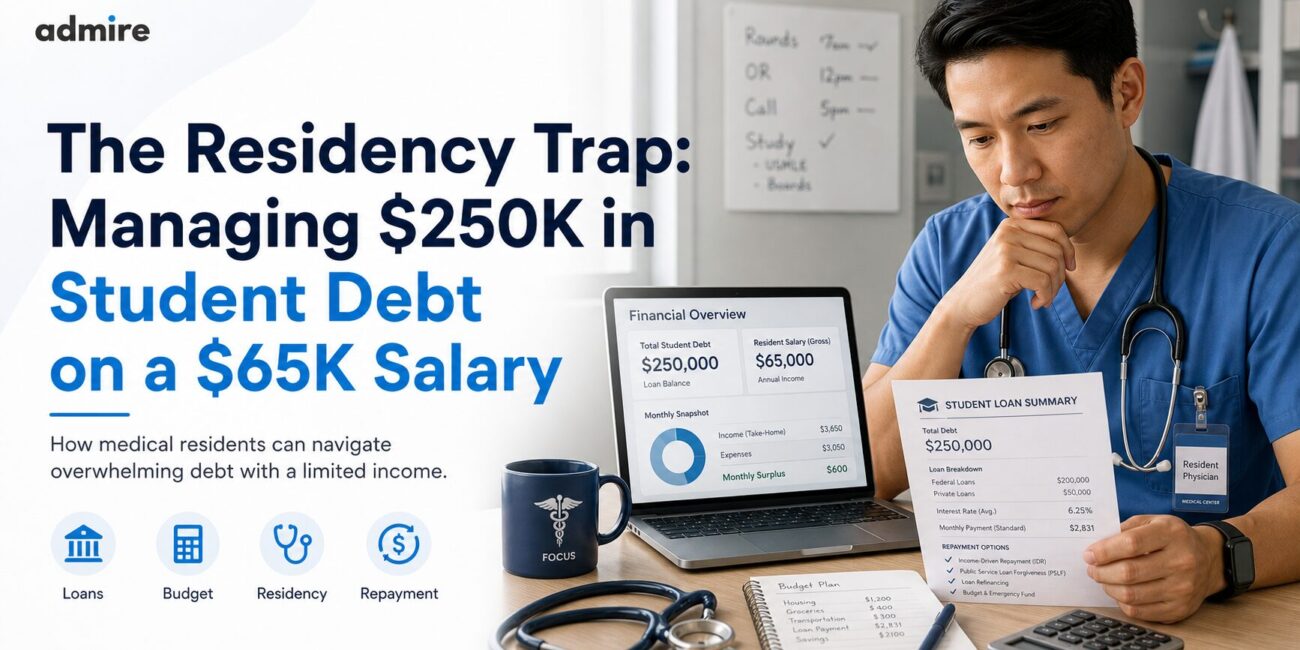
You just matched. Congratulations, genuinely. You survived organic chemistry, four years of medical school, Step exams, and the emotional gauntlet of Match Day. You are about to become a physician.
You are also about to earn $65,000 a year while carrying a quarter-million dollars in student debt.
That math doesn’t work on paper. It barely works in practice. But here’s the thing nobody tells you on Match Day: residency is a financial pressure cooker with a known expiration date, and the decisions you make during these 3 to 7 years will determine whether you walk into your attending salary with a clean financial runway or drag six figures of accumulated interest behind you for another decade.
This is your financial survival guide for the residency years. Not the theory. The actual math.
The Math Nobody Shows You Before Match Day
Let’s be direct about the numbers, because most financial advice for residents dances around them.
The average medical school graduate in 2025 carries $216,659 in educational debt. If you attended a private institution or borrowed for undergrad, you’re likely above $250,000. Some specialties that require additional training push graduates past $350,000.
Meanwhile, the median PGY-1 salary in 2025-2026 is approximately $64,000 to $68,000, depending on your program and region. After federal and state taxes, that nets roughly $4,100 to $4,400 per month.
Now run the standard 10-year repayment calculation on $250,000 at the current federal graduate rate of 7.94%:
| Metric | Amount |
|---|---|
| Monthly payment (standard 10-year) | $3,051 |
| Your monthly take-home pay | $4,200 |
| Percentage of income to loans | 72.6% |
| Left for rent, food, insurance, everything else | $1,149 |
Nobody is making that payment on a resident’s salary. Which is exactly why the standard plan isn’t your plan during residency. The question is: what IS your plan?
Federal Repayment During Residency: IBR, RAP, or Standard?
You have three realistic options for your federal loans during residency. Each one comes with trade-offs that compound over years, so choose deliberately, not by default.
Income-Based Repayment (IBR)
IBR caps your monthly payment at 10 to 15 percent of your discretionary income, depending on when you first borrowed. For a PGY-1 earning $65,000, that works out to roughly $350 to $500 per month. That’s manageable. The catch: at that payment level, you’re not covering the monthly interest on a $250K balance at 7.94%. Your balance grows every month you’re in residency. After a 5-year residency, your original $250K could be $290K or more.
IBR makes sense if you’re pursuing Public Service Loan Forgiveness (more on that below) or if you need the lowest possible payment to survive financially. It does NOT make sense if your plan is to refinance and pay aggressively once you’re an attending, because you’ll refinance a larger balance than you started with.
Repayment Assistance Plan (RAP)
RAP is the new income-driven plan created by the One Big Beautiful Bill Act, taking effect July 1, 2026. Payments range from 1% to 10% of your adjusted gross income, with a minimum of $10 per month. For residents, the payment will likely be similar to or slightly lower than IBR. RAP also deducts $50 from your monthly payment for each dependent, which helps if you have a family during training.
The key difference: RAP forgives any remaining balance after 30 years, but that forgiveness is now taxable income under OBBBA. If you’re on the PSLF track (10-year forgiveness at a qualifying employer), PSLF remains tax-free and is generally the better path.
Standard Repayment (the “grit your teeth” option)
Some residents with high-paying moonlighting income or a spouse’s salary can swing a modified standard payment. This prevents negative amortization and means you refinance a SMALLER balance when you become an attending. But for most single residents in high cost-of-living cities, this isn’t realistic. Don’t sacrifice your emergency fund or mental health to make standard payments. That’s not discipline; it’s financial self-harm.
The PSLF Clock: Why Your Residency Counts (and When It Doesn’t)
Here is the single most important thing most residents miss: if you’re training at a 501(c)(3) nonprofit hospital (and the vast majority of academic medical centers qualify), your residency payments count toward Public Service Loan Forgiveness.
PSLF forgives your remaining federal loan balance after 120 qualifying monthly payments (10 years) while working for a qualifying employer. The forgiveness is tax-free. On a $250K balance, that’s potentially $150,000 or more in forgiven debt.
A 5-year residency gets you 60 of those 120 payments. You’re halfway there before you even start your career as an attending. If you stay at a nonprofit hospital or move into academic medicine, government service, or another qualifying employer, you can hit 120 payments just 5 years into your attending career.
When it doesn’t count:
PSLF requires that you’re on an income-driven repayment plan (IBR, RAP, or the old PAYE/ICR) AND employed by a qualifying employer AND making payments on time. If your hospital is a for-profit entity, those payments don’t count. If you’re in deferment or forbearance instead of active repayment, those months don’t count. And if you refinance your federal loans into a private loan, you lose PSLF eligibility permanently. That last one is critical.
Should You Refinance During Residency? The Case For and Against
The refinancing question during residency is one of the most debated topics in physician finance, and for good reason. The answer genuinely depends on your specific situation.
The case FOR refinancing during residency:
Private refinancing rates for borrowers with strong credit start below 4% for variable rates and around 5% for fixed. Your federal loans are at 6.39 to 8.94%. The interest savings on a $250K balance can be significant, even during residency. Some lenders offer residency-specific programs with lower payments during training and higher payments after. If you are NOT pursuing PSLF, refinancing stops the bleeding from negative amortization during residency.
The case AGAINST refinancing during residency:
Refinancing federal loans into private loans permanently eliminates PSLF eligibility, income-driven repayment access, and federal forbearance/deferment protections. If you might pursue PSLF, if your career path is uncertain, or if you need the safety net of income-driven payments, refinancing during residency is premature. The risk-reward calculus changes dramatically once you have an attending contract in hand.
A deeper look at when each path makes sense: A Clear Guide to Student Loan Refinancing
The Attending Transition: What Changes When Your Salary Triples
The median physician salary across specialties is roughly $250,000 to $350,000. After 3 to 7 years of earning $65K, that transition is the single largest income inflection point most people will ever experience.
This is when the real financial strategy kicks in. Most physicians make one of two mistakes at this stage:
1. Lifestyle inflation absorbs the raise. The new car, the house, the “I deserve this” purchases. Before they realize it, their monthly expenses have risen to match their income and their loan payments haven’t changed.
2. They stay on the income-driven plan by inertia. IBR recalculates based on your new income. On a $300K salary, IBR payments may actually exceed what aggressive repayment or refinancing would cost, and you’re paying more interest over time.
The attending transition is the optimal moment to reassess everything: refinance at your now-excellent debt-to-income ratio, switch to aggressive repayment, or confirm your PSLF timeline. If you’re not on the PSLF path, this is when refinancing typically makes the most financial sense, because your credit profile, income stability, and DTI ratio are all at their strongest.
For more on why the numbers work in your favor at this stage: Why Refinancing Makes Sense for Medical Professionals
Your 90-Day Checklist Before Residency Starts
If you’re starting residency in July 2026, here’s what to do in the next 90 days. Print this out. Put it on your fridge. You will be too exhausted during intern year to think about this clearly.
- Confirm your training hospital’s 501(c)(3) status. If it qualifies for PSLF, you want to know that NOW, not 3 years in.
- Submit your PSLF Employment Certification Form (ECF) within your first month. Don’t wait until year 10 to find out something was wrong.
- Enroll in IBR or RAP (available July 1). Do NOT go into deferment or forbearance. Every payment on income-driven repayment at a qualifying employer is a PSLF-qualifying payment.
- Set up autopay. Most servicers offer a 0.25% rate reduction for automatic payments, and you’ll never miss a payment during a 28-hour call shift.
- Create a bare-bones budget. You need 3 months of emergency savings before residency starts. If you can’t save that, reduce fixed expenses now.
- Check what refinancing rates you’d qualify for today. Even if you don’t refinance now, knowing your rate helps you make the attending-transition decision later. Admire lets you compare 17+ lenders with a soft credit pull.
- Understand the OBBBA changes taking effect July 1. New repayment plans, new borrowing rules, and new forgiveness tax treatment all affect your strategy.
- Talk to a tax professional about your state’s treatment of student loan interest deductions. Some states offer additional deductions beyond the federal $2,500 cap.
The Bottom Line
Residency is a financial trap only if you treat it like a permanent state. It’s not. It’s a defined period with a defined end date and a massive income increase waiting on the other side. The residents who come out ahead are the ones who make one clear decision early: am I on the PSLF path, or am I on the refinance-and-payoff path? Pick one, execute it deliberately, and don’t let the stress of training trick you into ignoring your loans for 5 years.
Your debt-to-income ratio is catastrophic right now. It won’t be forever. Plan for the transition, protect your options, and you’ll walk into your attending career with a strategy instead of a crisis.
See your real refinancing rates from 17+ lenders. Free, 3 minutes, no credit impact. →