There is one financial decision that will affect your net worth more than almost any other choice you make in your professional career, and most people make it based on a gut feeling.
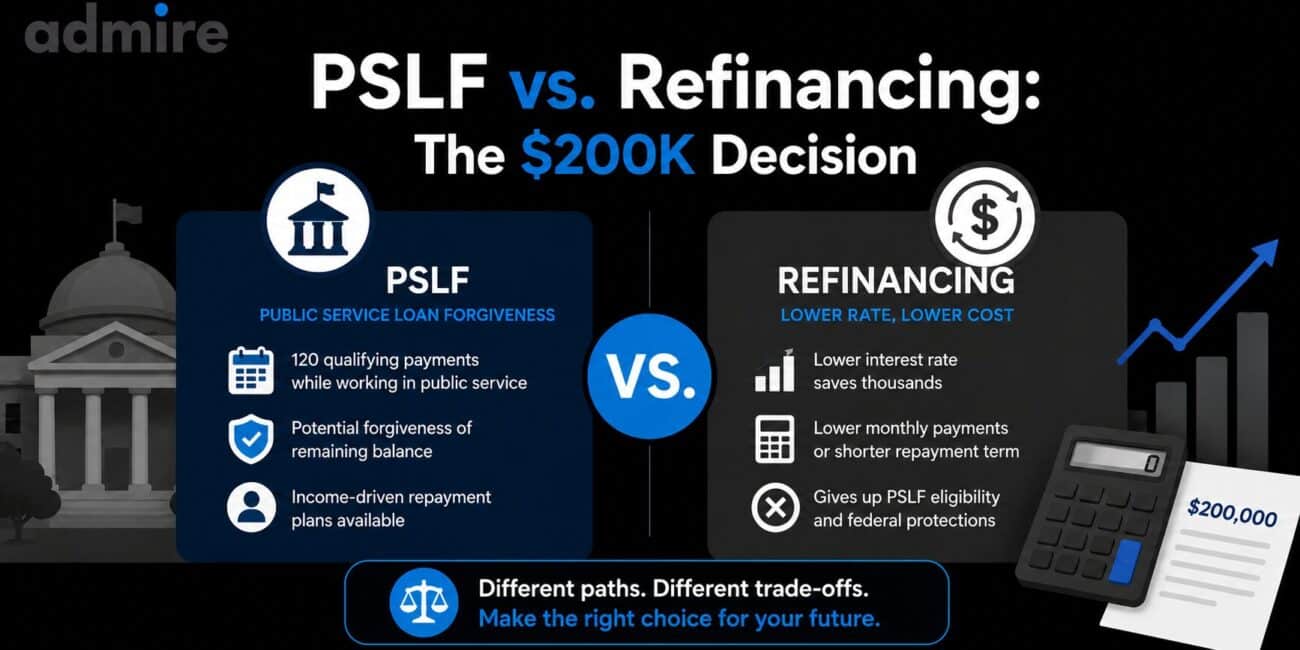
If you have six-figure federal student loans and work for (or plan to work for) a qualifying employer, the PSLF vs. refinancing decision can swing your finances by $100,000 to $200,000 in either direction. Get it right and you’re free of debt years early or with a massive forgiveness benefit. Get it wrong and you’ve either forfeited tax-free forgiveness you were entitled to, or spent a decade on a program you never completed.
This guide gives you the actual math and a decision framework. Not opinions. Numbers.
Why This Decision Is Worth More Than Your Next Raise
For a physician carrying $250,000 in federal student loans at 7.94%, here are the two paths side by side:
| Scenario | PSLF Path | Refinance Path |
|---|---|---|
| Interest rate | 7.94% (federal) | ~4.5% (private refi) |
| Monthly payment years 1-5 (residency) | ~$400 (IBR on $65K) | ~$600 (refi residency program) |
| Monthly payment years 6-10 | ~$1,800 (IBR on $300K salary) | ~$3,200 (aggressive 7-year payoff) |
| Total paid over repayment period | ~$132,000 | ~$264,000 |
| Amount forgiven | ~$180,000 (tax-free under PSLF) | $0 |
| Total cost of the degree (payments only) | $132,000 | $264,000 |
On paper, PSLF wins by $132,000. But PSLF requires 10 full years at a qualifying employer, on a qualifying repayment plan, making 120 qualifying payments without a single misstep. The refinancing path offers no forgiveness but complete freedom: you choose your employer, your repayment timeline, and your rate.
How PSLF Works in 2026 (Post-OBBBA Rules)
PSLF forgives the remaining balance on your federal Direct Loans after 120 qualifying monthly payments (10 years) while employed full-time by a qualifying employer. The forgiven amount is not taxable income.
Qualifying employers include:
- 501(c)(3) nonprofit organizations (most academic medical centers, nonprofit hospitals)
- Federal, state, local, and tribal government agencies
- Public interest law organizations
- Public universities and school districts
Qualifying repayment plans now include IBR (Income-Based Repayment) and the new RAP (Repayment Assistance Plan) created by OBBBA. Standard 10-year repayment also qualifies, though it defeats the purpose since there’s nothing left to forgive after 10 years of standard payments on the original term.
What OBBBA changed: IDR forgiveness (the 20-25 year kind on income-driven plans) is now taxable. But PSLF forgiveness remains tax-free. This makes PSLF even more valuable relative to simply riding an IDR plan to the 25-year mark, because the IDR “tax bomb” can be substantial. On a forgiven balance of $200,000, taxable forgiveness could mean a $50,000 to $70,000 tax bill.
The Real Math: PSLF vs. Refi for a $250K Balance
Let’s run three realistic scenarios for a physician finishing a 5-year residency and entering private practice or a hospital system:
Scenario A: PSLF (full 10 years at a qualifying employer)
- 5 years of residency payments on IBR: ~$400/month = $24,000 total
- 5 years of attending payments on IBR (salary $300K): ~$1,800/month = $108,000 total
- Total paid: $132,000
- Remaining balance forgiven (tax-free): ~$180,000
- Net cost: $132,000
Scenario B: Refinance after residency (aggressive payoff)
- 5 years of residency payments on IBR: ~$400/month = $24,000 (balance grows to ~$290K)
- Refinance at 4.5%, pay aggressively at $4,500/month for 7 years: $378,000 total
- Total paid: $402,000
- Forgiven: $0
- Net cost: $402,000
Scenario C: Refinance during residency (lock low rate early)
- Refinance $250K at 4.5% immediately, residency payments of $600/month for 5 years: $36,000
- Attending payments of $3,500/month for 7 years: $294,000
- Total paid: $330,000
- Forgiven: $0
- Net cost: $330,000
The difference between Scenario A and Scenario C is nearly $200,000. That’s a house down payment, a decade of retirement contributions, or financial freedom a decade earlier. But Scenario A only works if you stay at a qualifying employer for the full 10 years.
The IDR Tax Bomb: Why OBBBA Changed the Equation
Some borrowers consider a third option: stay on IDR for 20-25 years and receive forgiveness at the end. Under OBBBA, that forgiveness is now taxable income. Here’s why this matters:
If your balance is $250,000 and it grows to $400,000 over 25 years of IDR payments (negative amortization compounds), the forgiven amount of $400,000 gets added to your taxable income in the year of forgiveness. At a 35% marginal tax rate, that’s a $140,000 tax bill due in a single year.
PSLF avoids this entirely because PSLF forgiveness is tax-free. This is the single biggest advantage of PSLF over other forgiveness pathways and why it’s worth protecting if you’re eligible.
Decision Tree: 5 Questions That Determine Your Best Path
Answer these honestly:
1. Are you currently employed by (or committed to working for) a PSLF-qualifying employer for the next 5-10 years?
If yes, PSLF is likely your best path. If your career plans are uncertain or you want to work in private practice, refinancing gives you more flexibility.
2. Is your balance above $150,000?
Higher balances benefit more from PSLF because the forgiven amount is larger. For balances under $80,000, the forgiveness amount may not justify 10 years of commitment.
3. Is your income going to rise significantly (2-3x or more)?
Physicians, lawyers, and dentists see dramatic income increases after training. High income makes aggressive refinanced payoff more feasible. But high income also increases IBR payments, reducing the PSLF forgiveness amount.
4. How many qualifying payments have you already made?
If you’re 60 or more payments in, the opportunity cost of switching to refinancing is very high. Stay the course. If you’re at zero, both paths are fully open.
5. Can you handle the career constraints?
PSLF requires qualifying employment for the full 10 years. If the right career opportunity comes at a for-profit employer in year 7, will you turn it down to protect PSLF? If that constraint feels unacceptable, refinancing preserves your freedom.
Hybrid Strategies: Keeping Some Federal, Refinancing the Rest
One approach worth considering: if you have both undergraduate and graduate federal loans, you can refinance the undergraduate loans (which are typically at lower balances and lower rates) while keeping the graduate loans federal for PSLF. This preserves your PSLF eligibility on the high-balance loans while locking a better rate on the smaller ones.
Similarly, some borrowers keep only their Direct Loans federal (for PSLF eligibility) and refinance any private loans or consolidated loans that aren’t PSLF-eligible anyway.
The key: never refinance a federal loan that you want to count toward PSLF. Once it’s private, that eligibility is gone permanently.
The Bottom Line
PSLF is a powerful benefit that can save you $100,000 to $200,000. Refinancing offers lower rates, faster payoff, and career freedom. The right choice depends on your balance, your career plans, and your tolerance for constraints.
Don’t guess. Run the numbers with your actual balance, your actual income trajectory, and your actual career plans. The 90 minutes it takes to do this analysis is the most valuable financial planning you’ll do this year.
More on the general case for refinancing: A Clear Guide to Student Loan Refinancing
Decided refinancing is your path? See your real rate in 3 minutes. 17+ lenders, no credit impact. →