Currently, the student loan refinancing market advertises rates starting at 3.84% APR. Those same lenders cap out at 10.15%.
That’s a 6.31 percentage point spread separating the best rate from the worst. On a $60,000 loan over 10 years, that difference translates to approximately $7,000 in total interest paid.
Two borrowers with similar loan balances can end up in completely different financial realities based on how lenders assess their risk.
Risk-based pricing isn’t new. But the way it operates in student loan refinancing creates a market where eligibility doesn’t equal affordability, and where the factors that matter most aren’t the ones borrowers focus on.
The Credit Score Mirage
Most lenders advertise minimum credit score requirements in the mid-600s. That number gets you in the door.
It doesn’t get you the rate you saw advertised.
Borrowers typically need scores in the mid-700s to access the “best rates” that lenders promote. A score at the lower end of the acceptable range means you qualify, but at significantly less favorable terms.
The gap between qualifying and actually benefiting can cost thousands over the life of the loan.
Credit scores function as a gatekeeper, not a rate determinant. They tell lenders whether to consider you. Other factors tell them what to charge you.
DTI Ratio: The Silent Disqualifier
In a recent survey, 48% of refinancing applicants reported rejection due to high debt-to-income ratios. Only 14% were rejected for credit scores.
Lenders prefer DTI ratios below 50%, but approval odds improve significantly under 40%. The best rates are reserved for those under 35%.
DTI measures how much of your gross monthly income goes toward debt payments. It’s a direct signal of financial capacity. A borrower with a 750 credit score and a 45% DTI ratio will get worse terms than a borrower with a 720 score and a 30% DTI.
The market penalizes leverage more than it rewards credit history.
Financial advisors recommend keeping DTI under 35% not just for approval odds, but because beyond that threshold, quality of life suffers. You have less money for anything outside of debt service.
This creates a structural problem: the borrowers who would benefit most from lower monthly payments via refinancing are often the same ones whose DTI disqualifies them from accessing better rates.
Employment Stability as Hidden Variable
Lenders don’t just evaluate income levels. They prioritize consistent employment and view frequent job changes as red flags.
A career transition, even a lateral move that increases income, can hurt refinancing eligibility in the short term. The system penalizes mobility.
This creates a hidden tax on career optimization. Borrowers who switch jobs to increase earnings may find themselves temporarily locked out of better refinancing terms, even though their financial position improved.
The lag between career moves and lender comfort with those moves can span months.
The Comparison Advantage Most Borrowers Don’t Use
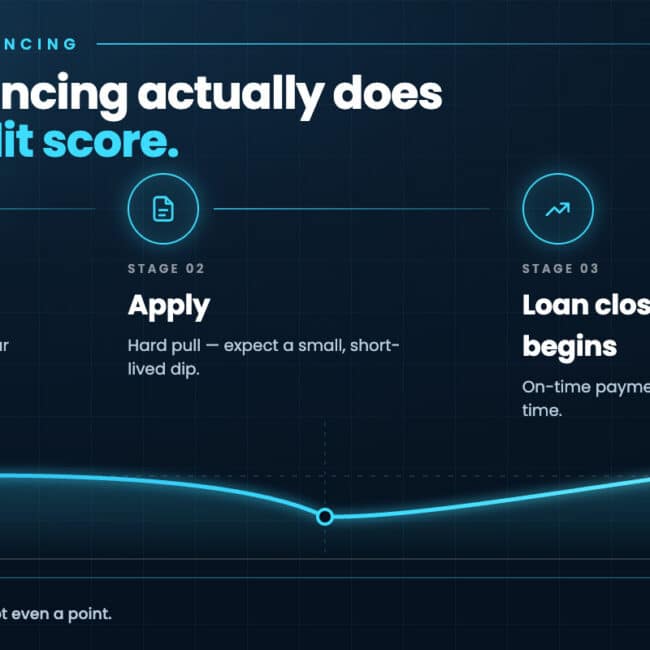
Most private lenders allow borrowers to check rates through soft credit inquiries. These don’t affect your credit score.
When borrowers submit full applications, credit bureaus lump multiple hard inquiries within a 14-to-45-day window into a single impact. This “rate shopping exception” removes the penalty for comparison.
The infrastructure exists to make comparison costless. Information asymmetry keeps borrowers from using it.
Many borrowers still avoid comparison shopping due to fear of credit damage, even though the system is designed to accommodate it.
What This Means for Your Next Move
Risk-based pricing means your rate isn’t just about your credit score. It’s about the full picture of your financial capacity and stability.
The factors that matter most:
- Debt-to-income ratio (often more decisive than credit score)
- Employment consistency (stability weighs more than income level alone)
- Credit score threshold (mid-700s for best rates, mid-600s for eligibility)
- Loan amount and term (affects lender risk exposure)
If you’re planning to refinance, focus on reducing your DTI before you apply. Pay down high-interest debt. Delay refinancing if you recently changed jobs and can wait a few months to establish employment history.
Use soft credit pulls to compare rates across multiple lenders. The comparison layer is where you capture the rate differential that determines whether refinancing saves you $2,000 or $7,000.
Admire’s Find My Rate tool aggregates offers from multiple lenders using a single soft credit pull—no score impact, no repetitive applications. You see personalized rates side-by-side and choose based on actual terms, not advertised ranges.
The market is designed to make comparison difficult. The tools to make it effortless exist. The gap between those two realities is where thousands of dollars get left on the table.