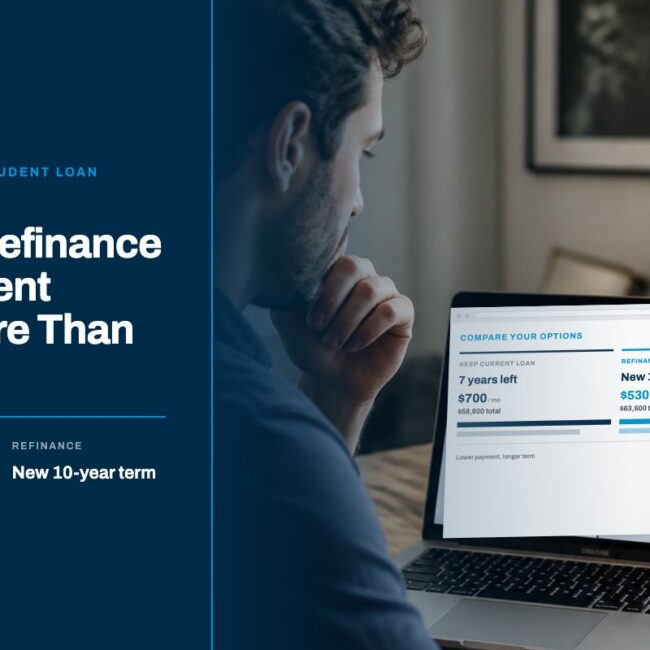
The short answer: Consolidation combines federal student loans into one new federal loan at roughly the same interest rate, and you keep every federal protection. Refinancing replaces your loans with a new private loan at a new rate based on your credit and income. Consolidation simplifies. Refinancing can lower your cost, but it ends federal benefits.
If you have been putting this question off because the two words sound interchangeable, you are in good company. Lenders, servicers and even some financial sites use them loosely, and it is one of the most common mix-ups we see. The difference matters, though, because one of these choices is easy to undo and the other is not.
Here is how each one works, who each one is for, and how to tell which fits where you are right now.
What is student loan consolidation?
Consolidation, in the formal sense, means a Direct Consolidation Loan from the U.S. Department of Education. You take several federal loans, combine them into a single new federal loan, and make one monthly payment instead of several.
A few things are true of every Direct Consolidation Loan:
- Your rate does not really change. The new rate is the weighted average of the loans you combine, rounded up to the nearest one-eighth of a percent. You will not save money on interest by consolidating.
- Your loans stay federal. Income-driven repayment, Public Service Loan Forgiveness eligibility, deferment and forbearance all remain available, subject to each program’s rules.
- There is no fee and no credit check. You apply through studentaid.gov, and your credit history is not part of the decision.
- Unpaid interest is added to your balance. Any outstanding interest capitalizes when the new loan is created, so your principal can go up slightly.
Consolidation is genuinely useful for tidying up a messy set of federal loans, or for bringing older loan types into the Direct Loan program so they qualify for programs they otherwise would not.
One 2026 change worth knowing: under the One Big Beautiful Bill Act, a consolidation loan made on or after July 1, 2026 generally has access to the newer federal repayment plans only, and Parent PLUS loans consolidated on or after that date must be repaid under the standard plan. If you are counting on a specific repayment plan, confirm eligibility on studentaid.gov before you consolidate.
What is student loan refinancing?
Refinancing means a private lender pays off your existing student loans and issues you one new private loan. The new loan has its own interest rate, term and monthly payment, all set by the lender based on your financial profile.
That last part is the whole point. Your rate is not averaged from your old loans; it is priced fresh, based on your credit score, income, debt-to-income ratio and the term you choose. If your finances have improved since you first borrowed, such as a steady job, a better credit score, lower debt, then you may qualify for a lower rate than the one you have now. How lenders price refinancing walks through exactly which factors move your offer.
Refinancing works for federal loans, private loans, or a mix of both. But when federal loans are refinanced they become private loans, permanently. That means giving up access to income-driven repayment, federal forgiveness programs, and federal deferment and forbearance options. Our breakdown of what you give up when you refinance federal loans covers each of those in detail, and it is worth reading before you refinance anything federal.
See what refinancing would actually offer you
Checking your rate on Admire uses a soft credit check, so it will not affect your credit score. You will see real offers from multiple lenders side by side — and if consolidation turns out to be the better fit, that is a useful answer too.
Consolidation vs. refinancing, side by side
| Direct Consolidation | Refinancing | |
|---|---|---|
| Who offers it | U.S. Department of Education | Private lenders, banks and credit unions |
| Which loans qualify | Federal loans only | Federal loans, private loans, or both |
| How your rate is set | Weighted average of your current rates, rounded up | Priced fresh on your credit, income and term |
| Can it lower your rate? | No | It can, if your profile qualifies |
| Credit check | None | Soft check to see rates; hard check when you apply |
| Federal protections | Kept | Given up for any federal loans refinanced |
| Cost to apply | No fee | Typically no application fee |
| Can you reverse it? | You remain in the federal system | No — a private loan cannot be made federal again |
When consolidation makes more sense
Consolidation is usually the better tool when keeping federal protections matters more than lowering your rate. That tends to be true if:
- You work in public service or plan to. If you are pursuing PSLF, refinancing would remove your eligibility entirely. Our PSLF vs. refinancing guide runs the numbers on both paths.
- Your income is uncertain. A new career, a planned move, freelance work or a return to school are all good reasons to keep access to income-driven repayment for now.
- You mainly want one payment. If juggling several federal servicer accounts is the problem, consolidation fixes that without any trade-off on protections.
- You have older federal loan types. Some older federal loans only become eligible for certain programs once they are consolidated into a Direct Loan.
When refinancing makes more sense
Refinancing is usually the better tool when lowering your total cost is the goal and you are comfortable with what you give up. That tends to be true if:
- Your loans are private already. Private loans cannot go into a Direct Consolidation Loan at all, and they carry no federal protections to lose. For most private-loan borrowers, refinancing is the only way to combine loans or change their rate.
- Your finances are stronger than when you borrowed. Stable income and good credit are what earn a lower rate, and many recent graduates reach that point in their first few years of work.
- You have a clear plan to repay. If you do not expect to use income-driven repayment or forgiveness, the federal protections you would give up may be worth less to you than the interest you could save.
- You want to release a cosigner or change your term to fit a life goal – paying off faster before buying a home, or lowering your payment to make room for a wedding or a business.
If you are still unsure whether you are a good candidate, who should (and should not) refinance in 2026 is a quick self-check.
Can you do both?
Yes, and for many borrowers with mixed loans, a split approach is the most sensible answer. You can consolidate your federal loans to keep them federal and simplify them, and separately refinance only your private loans to go after a lower rate.
That way the loans that carry protections keep them, and the loans that never had protections get the benefit of a fresh price. You end up with two payments rather than one, which is a small cost for keeping your options open.
Three mix-ups worth clearing up
“Private student loan consolidation” is refinancing. When a private lender offers to consolidate your loans, what it is offering is a refinance: a new private loan at a new rate. There is no private version of a Direct Consolidation Loan.
Consolidation does not save money on interest. Because the rate is an average rounded up, consolidation can leave your total cost the same or slightly higher, especially if a longer term is chosen. Its value is simplicity and program access, not savings.
Checking refinance rates does not hurt your credit. Seeing your rates on a marketplace like Admire uses a soft check. The hard inquiry only happens when you choose a lender and formally apply, and its effect is small and temporary. Does refinancing hurt your credit? explains the timing.
How to decide in four questions
- Are your loans federal, private, or both? Private-only means refinancing is the relevant option. Federal or mixed means read on.
- Will you use PSLF or income-driven repayment? If yes, or maybe, keep federal loans federal.
- Has your credit or income improved since you borrowed? If yes, refinancing may earn you a lower rate.
- Would a lower rate change something real for you? Buying a home sooner, traveling, building savings. If the savings would matter to your life, it is worth seeing the numbers.
If your answers point toward refinancing, our complete guide to refinancing in 2026 walks through the process from first rate check to first payment. And when you are ready, comparing refinancing offers on Admire takes a few minutes and will not affect your credit score.
Frequently asked questions
Is student loan consolidation the same as refinancing?
No. Consolidation combines federal loans into one new federal loan at a weighted-average rate and keeps federal protections. Refinancing replaces loans with a new private loan at a new rate based on your credit and income, and any federal loans included lose federal protections.
Can you consolidate private student loans?
Not through the federal Direct Consolidation program, which accepts federal loans only. Private loans can be combined by refinancing them with a private lender into one new loan, which is what private lenders mean when they offer “private consolidation.”
Does consolidating student loans lower your interest rate?
No. A Direct Consolidation Loan’s rate is the weighted average of the loans being combined, rounded up to the nearest one-eighth of a percent. Refinancing is the option that can lower your rate, depending on your credit profile.
Can you refinance a consolidated federal loan?
Yes. A Direct Consolidation Loan can be refinanced with a private lender like any other federal loan. Doing so turns it into a private loan and ends its federal protections, so it is worth weighing those first.
Should I consolidate or refinance my student loans?
Consolidation usually fits borrowers who want to keep federal protections such as income-driven repayment or PSLF. Refinancing usually fits borrowers with private loans, or with strong credit and stable income who want a lower rate and do not expect to need federal programs.
Admire is not a lender and does not make credit decisions. All rates and terms are determined by participating lenders and depend on your individual financial situation. Not all consumers will qualify for advertised rates and terms. See our full disclaimers.