Quick answer: Refinance private student loans when a real offer clearly beats your current rate and term without wrecking your cash flow. Treat federal refinance as a permanent trade — lower rate only if you are confident you will never need income-driven repayment, PSLF, or federal hardship tools.
This guide is for graduates and parents who are “refi-curious” after 2026 repayment changes and want a decision framework before they click apply.
What “refinancing” means (and what it does not)
Student loan refinancing means a private lender pays off your existing loan(s) and issues a new private loan with new rate, term, and rules.
It is not:
- Federal Direct Consolidation (stays in the federal system)
- Switching federal repayment plans
- Automatic forgiveness
Fact: Once federal loans are refinanced with a private lender, those balances leave the federal system. Income-driven plans, PSLF eligibility on that debt, and most federal deferment/forbearance options do not follow you.
2026 context borrowers keep getting wrong
Reporting through 2026 describes major federal repayment churn — including the end of SAVE and notices pushing borrowers toward other federal plans or private refinance. That pressure makes refinance feel like the default move. It should not be.
Assumption to challenge: “My payment is going up on a federal plan, so I must refinance.”
Better question: “Is the federal benefit stack still worth more than the interest I might save?”
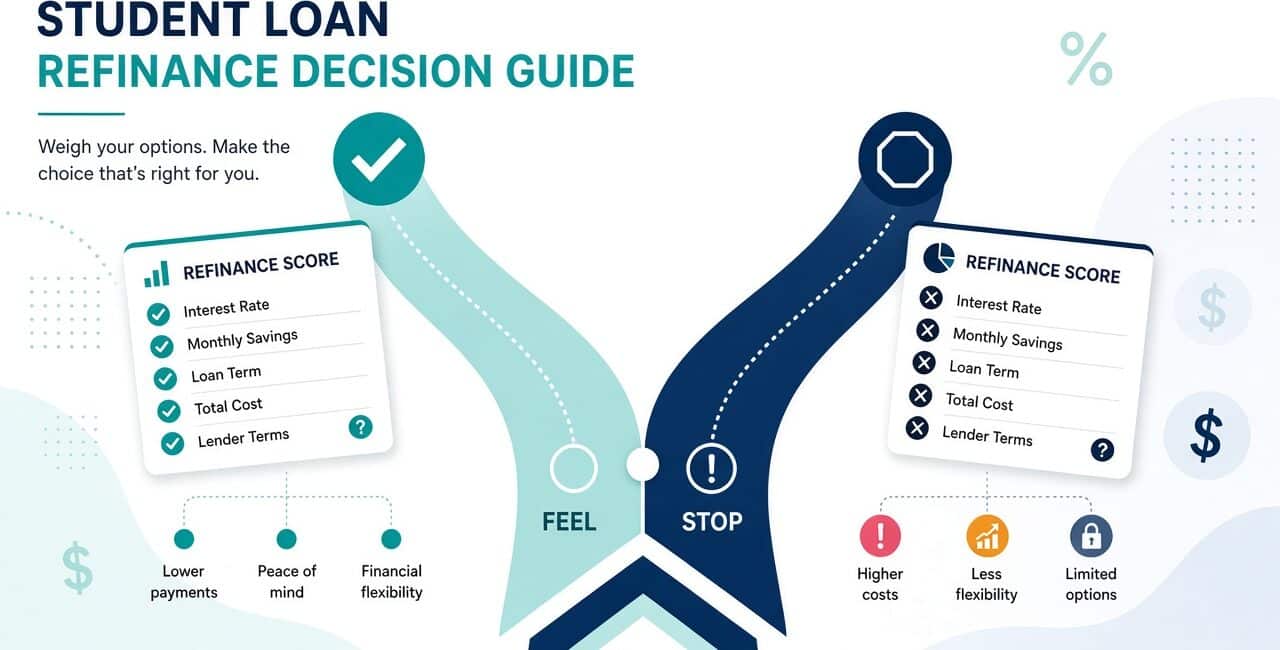
The refi candidate scorecard
Use this as a yes/no screen before you shop rates.
Strong private-loan refinance candidates
- Mostly or entirely private student debt
- Steady income + emergency savings (roughly 3+ months of expenses)
- Credit strong enough that soft-pull prequalification is likely to beat today’s rate
- Want one payment / want a cosigner released
- Can keep term similar (or shorter) so “lower payment” is not just a longer payoff in disguise
Strong federal-loan refinance candidates (higher bar)
- High, stable income and no realistic PSLF path
- Unlikely to need IDR if income dips
- Can show meaningful savings (many advisors use ~1%+ rate improvement and better total cost — not payment alone)
- Comfortable that federal safety nets are optional for them
Usually should not refinance (yet)
- Relying on or targeting PSLF / other federal forgiveness
- Income volatile, new job, or thin emergency fund
- Parent PLUS / complex federal situations where remaining federal options still matter
- “Save $40/month” only because the term jumped from 10 to 20 years
- Shopping “as low as” ads instead of real prequalified offers
Federal vs private: the tradeoff table
| If your loans are… | Refinancing usually means… | Keep federal when… |
|---|---|---|
| Private only | New rate/term; fewer hidden tradeoffs | You cannot beat current rate/term on total cost |
| Federal only | Permanent loss of federal benefits on that debt | You may need IDR, PSLF, or hardship tools |
| Mixed | You can refinance private first, leave federal alone | Federal piece still has strategic value |
How to compare offers like an adult (not a brochure)
- List each loan: balance, rate, federal vs private, months left.
- Soft-pull compare real offers (rate, APR, term, monthly, total estimated cost).
- Match term length before you celebrate a lower payment.
- Stress-test: “If I lost my job for 3 months, which loan system do I want to be in?”
- Apply only to the winner — hard pulls are for the finalist, not the whole market.
Admire’s job here: one soft pull, side-by-side prequalified offers from multiple lenders (rate, term, payment, total estimated cost), then you apply direct with the lender. Free to use. No “you’re approved!” spam theater.
FAQ
Should I refinance federal student loans in 2026?
Only if the savings clearly outweigh losing federal repayment and forgiveness options forever. Private loans are the cleaner starting point.
Is a 1% lower rate enough?
Sometimes — especially on private loans with a similar term. On federal loans, run total cost and benefit loss, not rate alone.
Does checking rates on Admire hurt my credit?
Admire uses a soft pull for prequalification, which does not have the same score impact as a hard application pull.
Can I refinance some loans and not others?
Often yes. Many borrowers refinance private balances and keep federal loans federal.
Bottom line
Refinance when the math and the protections both still work in your favor. In 2026’s noisy repayment environment, the winners are borrowers who compare real offers — and who know when not to leave the federal system.
CTA: See your real prequalified refinance options on Admire.org — free, soft-pull comparison, apply direct with the lender you choose.