Nobody applies for a private student loan in September.
The applications come in spring, once the financial aid letters arrive and families can finally see the gap between what college costs and what they have been offered. That is when the rush happens, and it is also when families discover that the pieces they needed were things they could have handled months earlier.
So this is the fall version of the task. Not applying. Preparing, so that when spring comes the application takes an afternoon instead of a month.
Federal aid first — always
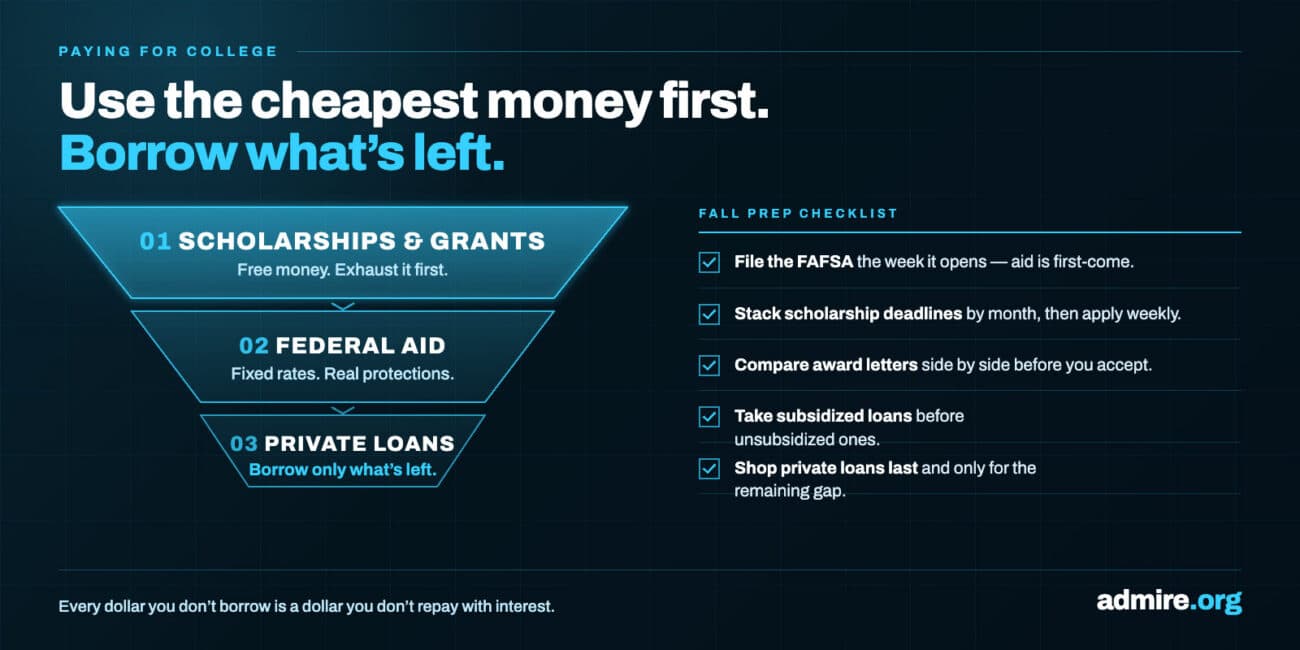
Before any of this, the order matters, and it does not change: scholarships and grants, then federal aid, then private loans for whatever is left.
Federal loans come with protections that private loans generally do not, such as income-driven repayment options, defined deferment and forbearance rules, and eligibility for federal forgiveness programs. Those protections have real value, and the way to keep access to them is to use federal aid first.
That means the FAFSA. It opens in the fall for the following academic year, and filing early matters because some aid is awarded on a first-come basis. Nothing on the private side should start until the FAFSA is submitted and you know what federal aid is available.
Private loans have a specific job in this sequence: covering the remaining gap after everything else is counted. Admire’s private student loans overview explains how that comparison works across lenders.
How much to actually borrow
The most consequential decision in this whole process is not which lender. It is how much.
A useful discipline: think about total borrowing across all four years against what the first year after graduation realistically pays. Keeping total student debt at or below expected first-year earnings tends to keep the eventual payment manageable on an entry-level salary. It is a rough guide rather than a rule, but it reframes the question in the right direction — from what can I get approved for to what will this feel like to repay.
Two habits that help:
- Look up actual starting salaries for the intended field, not aspirational ones. Program-level outcome data is published for most schools.
- Project all four years now, not just freshman year. Costs rise, and a first-year figure that feels comfortable can look different multiplied out.
The number that matters is not the monthly payment quoted at signing — it is what the loan costs across its full life. Total loan cost explains why that is the figure to compare.
What a cosigner is actually signing up for
Most undergraduates need a cosigner, because most eighteen-year-olds have little or no credit history. This is normal. What is worth being precise about is what the cosigner is agreeing to.
A cosigner is equally responsible for the debt. Not a reference, not a backup – a borrower. The loan appears on their credit report, it factors into their debt-to-income ratio when they apply for other credit, and if payments are missed, it affects their credit alongside the student’s.
Many private loans offer cosigner release after a period of on-time payments. It is worth understanding how that works before signing: release is not automatic. It generally requires submitting an application, and the student typically needs to qualify for the loan on their own at that point – the same income and credit review they could not pass at eighteen. Ask each lender what their specific criteria are, and what happens to the cosigner’s obligation in the event of the borrower’s death or disability.
None of this is a reason to avoid cosigning. It is a reason to have one clear conversation about it in the fall rather than a rushed one in April.
Compare private loan options in one place
Admire lets families compare private student loan offers from multiple lenders side by side, so you can see terms, rates and cosigner requirements together rather than filling out a separate form for each lender.
What lenders look at
Private student loan approval generally comes down to a few things, weighted mostly toward the cosigner when there is one:
- Credit history and score — primarily the cosigner’s for an undergraduate application
- Income and employment — evidence the payments can be made
- Debt-to-income ratio — existing obligations against income
- Enrollment status — the student must be enrolled, usually at least half-time, at an eligible school
- Citizenship or residency, which varies by lender
- Satisfactory academic progress, at some lenders
The point of listing these in September is that two of them are improvable between now and spring. Which brings us to the actual prep work.
The fall prep checklist
Six things worth doing before the end of the year.
1. File the FAFSA. Everything else depends on knowing the federal number first.
2. Have the cosigner check their credit. Pull the report, look for errors, dispute anything wrong. Corrections take time — this is the single most valuable thing to start early, because credit standing is what drives the rate offered.
3. Pay down revolving balances where possible. Credit utilization is one of the more responsive factors in a score, and improvement here can show up within a couple of months.
4. Avoid opening new credit accounts. New accounts and inquiries just before a loan application work against you. If a cosigner is considering a car loan or a new card, the ordering is worth a thought.
5. Estimate the gap. Cost of attendance, minus expected scholarships and grants, minus federal aid, equals the private loan need. An estimate in the fall means no surprises in April.
6. Compare lenders early, without applying. Rate checks generally use a soft credit inquiry, so families can see indicative terms without affecting anyone’s score. How to compare private student loans without hurting your credit score walks through the mechanics, and the same soft-versus-hard-pull logic covered in does refinancing hurt your credit applies here too.
A note on the federal side for 2026
Federal student aid rules have shifted recently, including changes affecting graduate and parent borrowing and a reshaped set of repayment plans. The details continue to be worked through, and the specifics that apply will depend on the academic year and the loan type.
The practical implication for families preparing now is narrow but real: do not rely on guidance from a few years ago, and confirm current federal borrowing limits and plan options at studentaid.gov or with the school’s financial aid office before assuming what federal aid will cover. If the federal portion turns out smaller than expected, the private gap is larger — and that is a difference better discovered in the fall than in the spring.
For parents already carrying student debt
One aside for the parents in this conversation. If you are cosigning for a child while still repaying your own student loans — including loans taken out for an older child — those existing balances factor into the debt-to-income ratio a lender reviews when assessing your cosigned application.
Refinancing existing debt to a lower payment can improve that ratio. It is not the right move for everyone, particularly where federal protections are involved, but it is worth knowing that the two decisions are connected. Admire’s refinancing overview covers how that works.
The short version
File the FAFSA. Check the cosigner’s credit and fix what is fixable. Estimate the gap. Compare lenders with soft pulls before committing to anything. Borrow against what the first year after graduation actually pays, not against what the school will let you take.
Do those in the fall and the spring application is a formality rather than a scramble.
Frequently asked questions
What are the requirements for a private student loan?
Lenders generally review credit history, income, debt-to-income ratio, enrollment status at an eligible school, and citizenship or residency. For undergraduates, most of this is assessed on the cosigner. Specific criteria vary by lender.
When should I apply for a private student loan?
Most families apply in the spring, after financial aid letters arrive and the remaining gap is known. Preparing in the fall — filing the FAFSA, reviewing the cosigner’s credit, estimating the gap — makes the spring application much faster.
Do I need a cosigner for a private student loan?
Most undergraduates do, because they have limited credit history and income. A cosigner is equally responsible for the debt, and the loan appears on their credit report. Some lenders offer cosigner release after a period of on-time payments, subject to an application and the borrower qualifying independently.
Should I take federal loans before private loans?
Generally yes. Federal loans carry protections that private loans typically do not, including income-driven repayment options and eligibility for federal forgiveness programs. Private loans are best used for the remaining gap after scholarships, grants and federal aid.
Does comparing private student loan offers affect my credit?
Checking indicative rates through a marketplace generally uses a soft credit inquiry, which does not affect the score. A hard inquiry occurs only when a formal application is submitted.
Admire is not a lender and does not make credit decisions. All rates and terms are determined by participating lenders and depend on your individual financial situation. Not all consumers will qualify for advertised rates and terms. See our full disclaimers.