July 1, 2026 is not just another date on the student loan calendar. It is the single largest policy shift in federal student lending since income-driven repayment was created.
On that date, the One Big Beautiful Bill Act (OBBBA) takes effect. The SAVE plan ends. Grad PLUS loans disappear for new borrowers. Parent PLUS gets capped. IDR forgiveness becomes taxable. And a new repayment plan called RAP replaces everything that came before.
If you owe $100,000 or more, this isn’t background noise. It’s the reset that determines your repayment strategy for the next decade. Here’s what actually changes, organized not by policy but by YOUR situation.
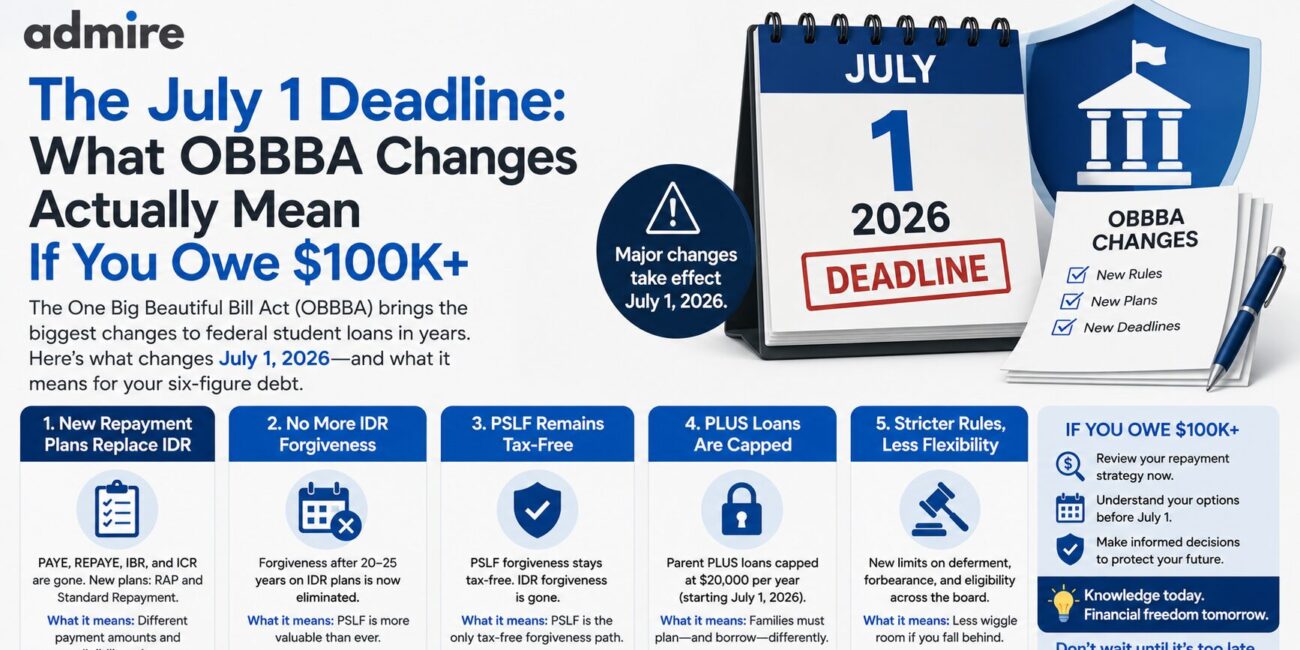
July 1 in 60 Seconds: The 5 Biggest Changes
- The SAVE plan ends. Borrowers on SAVE must transition to RAP (Repayment Assistance Plan) or another available plan.
- Grad PLUS loans are eliminated for new borrowers. Existing borrowers in continuous enrollment are grandfathered for 3 years.
- Parent PLUS is capped at $20,000 per student per year, with a $65,000 lifetime limit.
- IDR forgiveness becomes taxable. Balances forgiven after 20-30 years on income-driven plans are now treated as taxable income. PSLF forgiveness remains tax-free.
- RAP becomes the primary income-driven plan. Payments range from 1-10% of AGI, with a $10 minimum and $50/month deduction per dependent. Forgiveness after 30 years (taxable).
If You’re on the SAVE Plan: Your Transition Options
The SAVE plan ceases to exist on July 1. If you’re currently enrolled, you don’t lose your loans. You lose your repayment plan. Here’s what to do:
Option 1: Transition to RAP. This is the most direct replacement. RAP payments are 1-10% of your adjusted gross income, with a $10 monthly minimum. For most borrowers who were on SAVE, RAP payments will be similar. The key difference: RAP’s forgiveness timeline is 30 years (not 20-25), and that forgiveness is taxable.
Option 2: Switch to IBR. Income-Based Repayment remains available and may offer lower payments for some borrowers, particularly those who borrowed before July 1, 2014 (eligible for old IBR with 15% discretionary income and 25-year forgiveness). IBR payments still qualify for PSLF.
Option 3: Refinance. If you’re not pursuing PSLF and your income supports aggressive repayment, this may be the right moment to exit the federal system entirely. Private refinancing rates start significantly below federal rates for well-qualified borrowers.
What NOT to do: Don’t go into forbearance while you figure it out. Every month in forbearance is a month of accruing interest with no payment, no PSLF credit, and no progress. Make a decision before July 1.
If You’re a Graduate or Professional Student: The New Borrowing Reality
The Grad PLUS elimination hits current and prospective graduate students hardest. Here’s your reality by status:
Currently enrolled (before July 1): You’re grandfathered. You can continue borrowing up to cost of attendance for up to 3 years of continuous enrollment. Do not take a leave of absence or drop below half-time. Either action could void your grandfather status.
Starting Fall 2026 or later: New caps apply. Professional programs (MD, JD, DDS, PharmD, MBA): $50,000/year, $200,000 lifetime. Other graduate programs: $25,000/year, $100,000 lifetime. Any gap between these caps and your cost of attendance will need to be filled with private loans, institutional aid, or other sources.
More detail on the Grad PLUS elimination and how to fill the gap: Grad PLUS Is Dead After July 1
If You’re a Parent Borrower: What the Caps Mean for Your Family
Parent PLUS loans are now capped at $20,000 per student per year, with a $65,000 lifetime limit per student. Previously, parents could borrow up to the full cost of attendance with no cap.
For families at schools costing $50,000 or more per year, the $20,000 cap creates a significant gap. And unlike the Grad PLUS change, there is no grandfather provision for existing Parent PLUS borrowers. The cap applies to all new PLUS disbursements after July 1, regardless of when the student enrolled.
Your options for filling the gap:
- Increase student’s own federal borrowing (if not at the limit)
- Private student loans in the student’s name (may require co-signer)
- Private parent loans (compare rates, as PLUS charges 8.94% plus a 4.228% origination fee)
- Negotiate increased institutional aid
- Reevaluate school choice based on the new borrowing reality
Detailed breakdown: 2026 Parent PLUS Changes Under OBBBA
If You’re Pursuing PSLF: What Stays the Same (and What Doesn’t)
Good news first: PSLF itself is unchanged. The forgiveness is still tax-free. The 120-payment requirement is the same. Qualifying employers haven’t changed.
What did change:
- The SAVE plan (which counted toward PSLF) is gone. Switch to RAP or IBR. Both qualify.
- If you were counting on IDR forgiveness as a backup (in case you left qualifying employment), that forgiveness is now taxable. PSLF is now the only tax-free forgiveness pathway.
- Submit your Employment Certification Form now if you haven’t recently. The transition period is a good time to confirm everything is on track.
If you’re more than halfway through your 120 payments, stay the course. The value of tax-free PSLF just increased relative to every alternative.
The “Before July 1” Checklist (by Borrower Type)
All borrowers:
- Log into your servicer account and confirm your current repayment plan
- If on SAVE, contact your servicer about transitioning to RAP or IBR before July 1
- Check your loan balance, interest rate, and remaining term
PSLF seekers:
- Submit or update your Employment Certification Form
- Confirm your qualifying payment count
- Choose RAP or IBR as your new plan (both qualify for PSLF)
Graduate students:
- Confirm your grandfather status with your financial aid office
- If starting a new program Fall 2026+, calculate your funding gap under the new caps
- Compare private student loan options now: compare rates from 17+ lenders
Parent borrowers:
- Calculate your gap: school cost minus $20,000 PLUS cap minus student’s own federal aid
- Explore private loan alternatives before fall enrollment deadlines
- Have the family funding conversation now, not in August
Considering refinancing:
- Know your current federal rate and balance
- Check private rates (soft pull, no credit impact) to see if refinancing saves money
- If pursuing PSLF: do NOT refinance federal loans. If NOT pursuing PSLF: July 1 is a natural decision point
Frequently Asked Questions
What student loan changes take effect July 1, 2026?
Five major changes: SAVE ends and transitions to RAP, Grad PLUS is eliminated, Parent PLUS gets capped at $20,000/year, new borrowing caps take effect for graduate students, and IDR forgiveness becomes taxable income.
What is the RAP repayment plan replacing SAVE?
The Repayment Assistance Plan (RAP) replaces SAVE as the primary income-driven option. RAP calculates payments based on income and family size. Current SAVE enrollees are being transitioned automatically. Contact your servicer to verify details.
Does PSLF change under OBBBA?
The core PSLF structure remains intact: 120 qualifying payments, then tax-free forgiveness. However, repayment plan options have changed with the SAVE-to-RAP transition, which may affect monthly payment amounts during the qualifying period.
What should borrowers do before July 1, 2026?
Download your full loan data from StudentAid.gov, verify your servicer assignment, confirm your repayment plan transition, evaluate refinancing if applicable, and review whether your employer qualifies for PSLF.
The Bottom Line
July 1 isn’t a cliff. It’s a reset. The borrowers who come out ahead are the ones who understand their specific situation, make a deliberate choice, and execute before the deadline creates the choice for them.
Don’t wait until July. The checklist above takes 30 minutes. The decisions you make now will compound for years.
One thing that doesn’t change: comparing private rates is still free and takes 3 minutes. →
This article was researched and written by the Admire editorial team, drawing on federal student loan data, OBBBA legislation, and current lending market analysis. Admire.org is a borrower-first student loan marketplace. We are not a lender. Learn how Admire works.
Related Reading
- 8.8 Million Borrowers Are in Default. How Parents Can Protect Their Families.
- Building a College Funding Plan That Doesn’t Put Parents in Debt
- Co-Signing a Student Loan: The Fine Print Every Parent Needs to Read First
- Your Child’s Award Letter Just Arrived. Here’s How to Actually Read It.
- The Family Loan Conversation: How to Talk About Student Debt Before It’s Too Late
Compare Your Options
Ready to see what rates you qualify for? Admire.org lets you compare real rates from 20+ lenders with a soft credit check — no impact to your credit score.
- Compare Private Student Loan Options — Find the best private student loan rates for your situation
- Read Our Lender Reviews — Honest reviews of SoFi, Earnest, ELFI, and more