Here’s how most families fund college: they don’t plan. They accept the financial aid package, sign whatever loans are offered, and repeat each semester until graduation. By sophomore year, the parents have $40,000 in PLUS loans and no clear path out. By graduation, the family’s combined student debt exceeds what they’d need for a house down payment.
It doesn’t have to work this way.
With Parent PLUS now capped at $20,000 per year (starting July 1, 2026), the old approach of borrowing whatever the gap required is no longer even possible for many families. The cap is actually a gift in disguise: it forces the planning conversation that should have happened from the start.
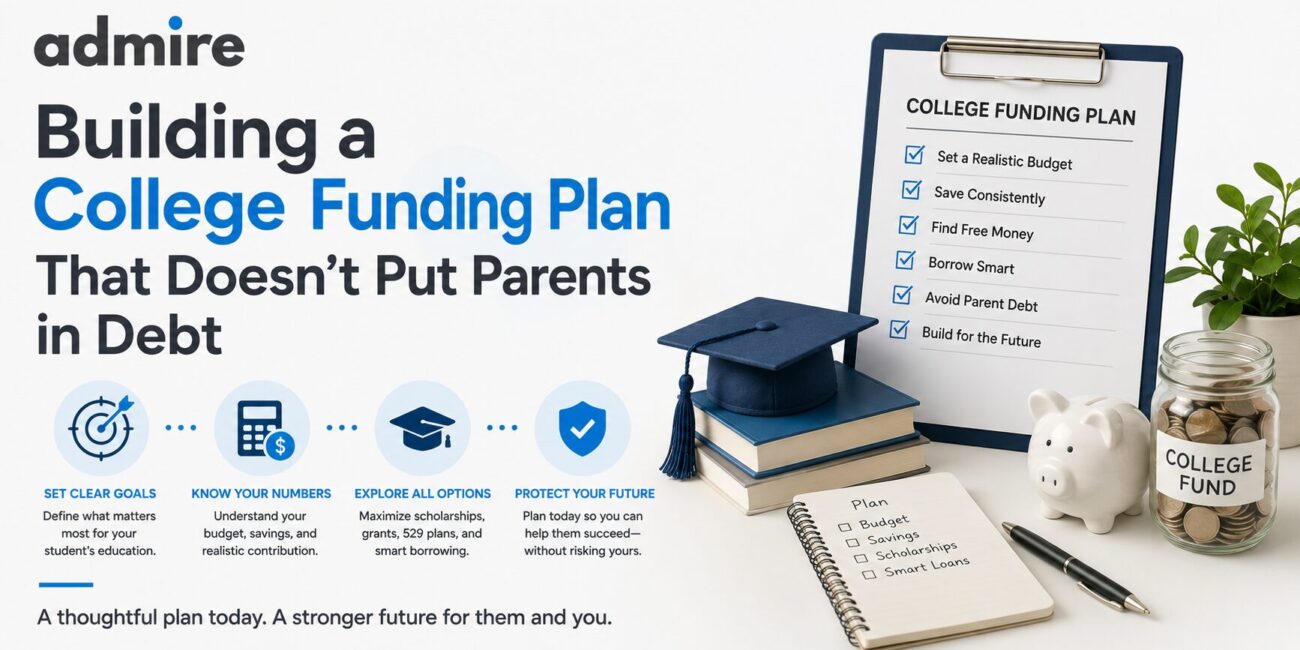
This is the 4-Layer Funding Model. It’s a structured approach that prioritizes the cheapest money first and protects the parent’s financial future at every step.
The Mistake: Funding College One Semester at a Time
The semester-by-semester approach fails because it optimizes for the wrong thing. Each semester, the family asks: “How do we cover this bill?” The correct question is: “How do we cover four years of bills without compromising the family’s financial stability?”
Here’s what happens when you fund reactively:
- Year 1 feels manageable. The aid package looks good. Parents take $15,000 in PLUS loans.
- Year 2: tuition increases 4%. The scholarship didn’t fully renew (GPA dipped). Parents take $22,000 in PLUS.
- Year 3: another tuition increase. The student changes majors, extending to a fifth year. Parents take $25,000 in PLUS.
- Year 4 (and 5): by now, parents owe $80,000+ in PLUS loans at 8.94%. Monthly payment after graduation: $1,006 for 10 years. Total repayment: $120,720.
None of this was the plan. But it was always the trajectory, because there was no plan.
The 4-Layer Funding Model
Each layer represents a funding source, prioritized from cheapest (free) to most expensive (borrowed). You fill each layer before moving to the next.
Layer 1: Savings and Assets (Cost: $0)
This includes 529 plans, education savings accounts, cash savings, and any assets specifically dedicated to education. Money in a 529 grows tax-free and withdrawals for qualified education expenses are tax-free.
If you’ve been saving, this is where it pays off. If you haven’t, don’t beat yourself up. Start the next layer.
Layer 2: Grants and Scholarships (Cost: $0, but requires effort)
This includes federal grants (Pell, FSEOG), state grants, institutional grants, merit scholarships, departmental awards, and outside scholarships. This is free money, but it requires applications, essays, FAFSA filing, and sometimes negotiation with the financial aid office.
Key point: institutional aid is often negotiable. If School A offers $10,000 more in grants than School B, and your child prefers School B, call School B’s financial aid office and ask them to match. They won’t always say yes. But they won’t say yes if you don’t ask.
Layer 3: Student Federal Loans (Cost: 6.39%, with protections)
Direct Subsidized and Unsubsidized Loans in the student’s name. Annual limits for dependent undergraduates range from $5,500 to $7,500. These loans carry the lowest interest rates, offer income-driven repayment options, and are eligible for PSLF. Accept these in full before moving to Layer 4.
Important: these are the student’s responsibility, not the parent’s. This distinction matters for both financial and developmental reasons. The student has skin in the game.
Layer 4: The Gap Strategy (Variable cost, requires comparison)
This is where the real decisions happen. After Layers 1-3, whatever gap remains needs to be filled. Your options:
Option A: Private student loans (in the student’s name, often with co-signer). Rates start below federal rates for well-qualified borrowers. No origination fees. The student builds credit. Requires the parent to understand co-signer liability (it’s significant).
Option B: Parent PLUS loans. Now capped at $20,000/year ($65,000 lifetime). Interest rate: 8.94% plus 4.228% origination fee. This is the most expensive federal option. Use it only after comparing private alternatives.
Option C: Home equity or personal loans. Sometimes offers lower rates than PLUS. Tax-deductible interest on home equity in some cases. Risk: you’re putting your house on the line for college.
Option D: Increased family income. A parent takes on additional work. The student works part-time or during summers. Not glamorous, but it reduces borrowing dollar for dollar.
Option E: Adjust the plan. Community college for the first two years. In-state school instead of out-of-state. Transfer to a less expensive program. This isn’t failure. It’s financial intelligence.
The Retirement Question: When Funding College Puts Your Future at Risk
Here is the hardest truth in college planning: you can borrow for college, but you cannot borrow for retirement.
Parents in their 40s and 50s who drain retirement savings or stop contributing to fund college tuition are making a trade that rarely works in their favor. Every dollar removed from a 401(k) at age 50 would have been worth roughly $4 at age 65 (assuming 7% annual returns). A $50,000 withdrawal today is a $200,000 shortfall in retirement.
The guideline: never reduce retirement contributions below your employer match to fund college expenses. That match is a 100% return on your money. No student loan interest rate comes close.
If the only way to make a school work is to sacrifice your retirement contributions, the school is too expensive. That’s not a judgment. It’s math.
Negotiating More Aid: Yes, You Can (and Should) Appeal
Financial aid appeals work more often than families think. Here’s when and how to do it:
When to appeal:
- Your financial situation has changed since the FAFSA was filed (job loss, medical expenses, divorce, death in family)
- Another school offered significantly more aid and your child prefers this school
- The award doesn’t reflect your family’s actual ability to pay
How to appeal:
- Call the financial aid office and ask about their “professional judgment” or “special circumstances” appeal process
- Submit a written letter explaining the circumstance and the gap between the aid offered and your ability to pay
- Include documentation: tax returns, medical bills, layoff notice, competing offer letters
- Be specific about the dollar amount you need. “We need an additional $8,000 per year to make this work” is more effective than “we need more money”
Schools want to enroll your child. If the appeal is reasonable and documented, there’s a real chance of additional aid. The worst they can say is no, and you’re no worse off than before.
Your 4-Year Funding Worksheet
Before committing to any school, fill this out for all four years:
| Funding Source | Year 1 | Year 2 | Year 3 | Year 4 | Total |
|---|---|---|---|---|---|
| 529/Savings | $____ | $____ | $____ | $____ | $____ |
| Grants & Scholarships | $____ | $____ | $____ | $____ | $____ |
| Student Federal Loans | $____ | $____ | $____ | $____ | $____ |
| Gap (Private/PLUS/Other) | $____ | $____ | $____ | $____ | $____ |
| Total Cost | $____ | $____ | $____ | $____ | $____ |
Assume 3-5% annual cost increases. Assume scholarships may not fully renew. Build in a buffer. If the 4-year total in the “Gap” row exceeds what you can realistically borrow and repay, it’s time for Option E: adjust the plan.
For help comparing the lenders who fill that gap: How Early Loan Comparison Leads to Smarter Borrowing
Frequently Asked Questions
How much should parents save for college?
Financial planners recommend covering at least one-third of projected costs through savings. For a $200,000 four-year cost, that means accumulating roughly $65,000 to $70,000. Even partial savings significantly reduce borrowing.
What is the best order to fund college costs?
Start with savings and 529 plans (zero cost), then maximize grants and scholarships, accept subsidized federal loans at 6.39%, and fill any gap with the most competitive private option or Parent PLUS as a last resort.
How much Parent PLUS can you borrow after July 2026?
Starting July 1, 2026, Parent PLUS loans are capped at $20,000 per student per year with a $65,000 lifetime limit. The interest rate is 8.94% with a 4.228% origination fee. Previously, parents could borrow up to the full cost of attendance.
Should parents borrow or let students take loans?
Students should borrow first through federal Direct Loans, which offer lower rates, income-driven repayment, and forgiveness options. Parents should only borrow after student limits are reached, and never more than they can repay without sacrificing retirement.
Can you negotiate a college financial aid package?
Yes. Contact the financial aid office with competing offers and documented changes in finances. About 25% of families who appeal receive additional aid. Present concrete financial information, not just requests for more money.
The Bottom Line
A funding plan isn’t exciting. It won’t trend on social media. But it’s the difference between a family that emerges from college with manageable debt and a clear path forward, and a family that’s blindsided by $100,000 in loans they never meant to accumulate.
Map it out. Layer by layer. Before you commit.
This article was researched and written by the Admire editorial team, drawing on federal student loan data, OBBBA legislation, and current lending market analysis. Admire.org is a borrower-first student loan marketplace. We are not a lender. Learn how Admire works.
Related Reading
- 8.8 Million Borrowers Are in Default. How Parents Can Protect Their Families.
- The July 1 Deadline: What OBBBA Changes Actually Mean If You Owe $100K+
- Co-Signing a Student Loan: The Fine Print Every Parent Needs to Read First
- Your Child’s Award Letter Just Arrived. Here’s How to Actually Read It.
- The Family Loan Conversation: How to Talk About Student Debt Before It’s Too Late
Compare Your Options
Ready to see what rates you qualify for? Admire.org lets you compare real rates from 20+ lenders with a soft credit check — no impact to your credit score.
- Compare Private Student Loan Options — Find the best private student loan rates for your situation
- Read Our Lender Reviews — Honest reviews of SoFi, Earnest, ELFI, and more